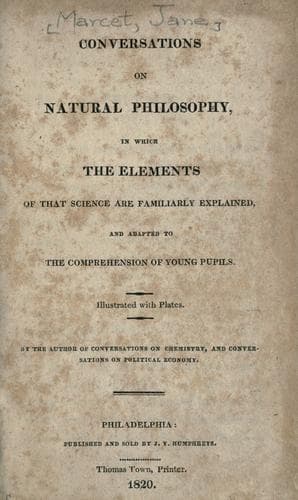
Conversations on Natural Philosophy, in which the Elements of that Science are Familiarly ExplainedMarcet, Mrs. (Jane Haldimand)
Science
Conversations on Natural Philosophy, in which the Elements of that Science are Familiarly Explained
Marcet, Mrs. (Jane Haldimand)
Physics
I must now take leave of you; but there remain yet many observations to
be made on fluids: we shall, therefore, resume this subject at our next
interview.
Questions
1. (Pg. 118) What are the two divisions of the science which treats of
the mechanical properties of liquids?
2. (Pg. 118) Of what do hydrostatics and hydraulics treat?
3. (Pg. 118) What is a fluid defined to be?
4. (Pg. 118) From what is fluidity supposed to arise?
5. (Pg. 118) Into what two classes are fluids divided?
6. (Pg. 119) What is said of the incompressibility of liquids, and what
experiment is related?
7. (Pg. 119) Ought this experiment to be considered as conclusive?
8. (Pg. 119) Why do fluids appear to gravitate more freely than solids?
9. (Pg. 120) When is a fluid said to be in equilibrium?
10. (Pg. 120) What is there in the nature of a fluid, which causes it to
seek this level?
11. (Pg. 120) What circumstances occasion oil to float upon water?
12. (Pg. 120) What is the nature and use of the instrument represented
in fig. 1, plate 13?
13. (Pg. 120) What difference is there in the gravitation of solid
masses, and of fluids?
14. (Pg. 121) What results as regards the pressure of fluids?
15. (Pg. 121) How is this illustrated by fig. 2, 3, plate 13?
16. (Pg. 121) From what does the lateral pressure proceed? and to what
is it proportioned, as exemplified in fig. 5, plate 13?
17. (Pg. 122) Has the extent of the surface of a fluid, any effect upon
its pressure downwards?
18. (Pg. 122) What will be the difference between the pressure upon the
bottom, and upon one side of a cubical vessel?
19. (Pg. 122) What occasions the upward pressure, and how is it
explained by fig. 4, plate 13?
20. (Pg. 123) How could the equilibrium of fluids be exemplified by
pouring water in at the spout of a tea-pot?
21. (Pg. 123) How by the apparatus represented at fig. 6, plate 13?
22. (Pg. 123) What is meant by the specific gravity of a body?
23. (Pg. 123) What do we in common mean by calling a body heavy, or
light?
24. (Pg. 124) Why would not the metals answer to compare other bodies
with?
25. (Pg. 124) What must be supposed equal in estimating the specific
gravity of a body?
26. (Pg. 124) What has been adopted as a standard for comparison?
27. (Pg. 125) What is the first step in ascertaining the specific
gravity of a solid?
28. (Pg. 125) What quantity of water will the solid displace?
29. (Pg. 125) Why will a solid weigh less in water than in air, and to
what will the loss of weight be equal?
30. (Pg. 126) What is the arrangement represented by fig. 7, plate 13?
31. (Pg. 126) What is stated of gold as an example?
32. (Pg. 126) In comparing a body with water, this is sometimes called
1000, what must be observed?
33. (Pg. 126) What quantity of water is displaced, by a body floating
upon its surface?
34. (Pg. 127) How can you find the specific gravity of a solid which is
lighter than water?
Public-domain text, read in full here on John Shaqi.
Reviews
Reviews
No reviews yet
Be the first to share your thoughts on this work.
Elsewhere in the archive
Join the Discussion
Join the discussion
Sign in to leave a comment or review.
Sign InorCreate an account