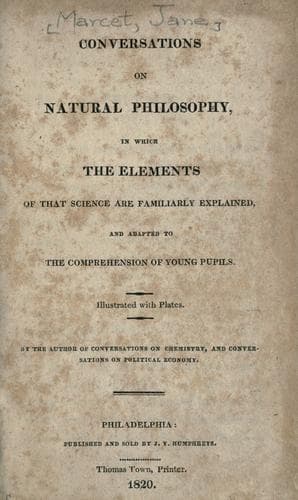
Conversations on Natural Philosophy, in which the Elements of that Science are Familiarly ExplainedMarcet, Mrs. (Jane Haldimand)
Science
Conversations on Natural Philosophy, in which the Elements of that Science are Familiarly Explained
Marcet, Mrs. (Jane Haldimand)
Physics
35. (Pg. 127) What is observed of a body whose specific gravity is the
same as that of water?
36. (Pg. 127) What is the reason that in drawing a bucket of water from
a well, its weight is not perceived until it rises above the surface?
37. (Pg. 128) Describe the instrument represented by fig. 8, plate 13,
and also how, and for what it is used?
CONVERSATION XI.
OF SPRINGS, FOUNTAINS, &c.
OF THE ASCENT OF VAPOUR AND THE FORMATION OF CLOUDS. OF THE FORMATION
AND FALL OF RAIN, &c. OF THE FORMATION OF SPRINGS. OF RIVERS AND LAKES.
OF FOUNTAINS.
CAROLINE.
There is a question I am very desirous of asking you, respecting fluids,
Mrs. B., which has often perplexed me. What is the reason that the great
quantity of rain which falls upon the earth and sinks into it, does not,
in the course of time, injure its solidity? The sun and the wind, I
know, dry the surface, but they have no effect on the interior parts,
where there must be a prodigious accumulation of moisture.
_Mrs. B._ Do you not know, that, in the course of time, all the water
which sinks into the ground, rises out of it again? It is the same
water which successively forms seas, rivers, springs, clouds, rain, and
sometimes hail, snow and ice. If you will take the trouble of following
it through these various changes, you will understand why the earth is
not yet drowned, by the quantity of water which has fallen upon it,
since its creation; and you will even be convinced, that it does not
contain a single drop more water now, than it did at that period.
Let us consider how the clouds were originally formed. When the first
rays of the sun warmed the surface of the earth, the heat, by separating
the particles of water, rendered them lighter than the air. This, you
know, is the case with steam or vapour. What then ensues?
_Caroline._ When lighter than the air, it will naturally rise; and now I
recollect your telling us in a preceding lesson, that the heat of the
sun transformed the particles of water into vapour; in consequence of
which, it ascended into the atmosphere, where it formed clouds.
_Mrs. B._ We have then already followed water through two of its
transformations; from water it becomes vapour, and from vapour clouds.
_Emily._ But since this watery vapour is lighter than the air, why does
it not continue to rise; and why does it unite again, to form clouds?
_Mrs. B._ Because the atmosphere diminishes in density, as it is more
distant from the earth. The vapour, therefore, which the sun causes to
exhale, not only from seas, rivers, and lakes, but likewise from the
moisture on the land, rises till it reaches a region of air of its own
specific gravity; and there, you know, it will remain stationary. By the
frequent accession of fresh vapour, it gradually accumulates, so as to
form those large bodies of vapour, which we call clouds: and the
particles, at length uniting, become too heavy for the air to support,
and fall to the ground.
Public-domain text, read in full here on John Shaqi.
Reviews
Reviews
No reviews yet
Be the first to share your thoughts on this work.
Elsewhere in the archive
Join the Discussion
Join the discussion
Sign in to leave a comment or review.
Sign InorCreate an account