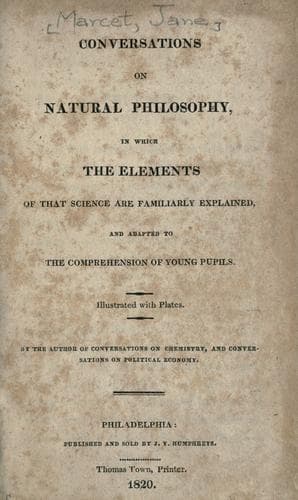
Conversations on Natural Philosophy, in which the Elements of that Science are Familiarly ExplainedMarcet, Mrs. (Jane Haldimand)
Science
Conversations on Natural Philosophy, in which the Elements of that Science are Familiarly Explained
Marcet, Mrs. (Jane Haldimand)
Physics
_Mrs. B._ No; excepting distilled water, rain water is the most pure we
can obtain; it is its purity which renders it insipid; whilst the
various salts and different ingredients, dissolved in spring water, give
it a species of flavour, which habit renders agreeable; these salts do
not, in any degree, affect its transparency; and the filtration it
undergoes, through gravel and sand, cleanses it from all foreign
matter, which it has not the power of dissolving.
_Emily._ How is it that the rain water does not continue to descend by
its gravity, instead of collecting together, and forming springs?
_Mrs. B._ When rain falls on the surface of the earth, it continues
making its way downwards through the pores and crevices in the ground.
When several drops meet in their subterraneous passage, they unite and
form a little rivulet; this, in its progress, meets with other rivulets
of a similar description, and they pursue their course together within
the earth, till they are stopped by some substance, such as rock, or
clay, which they cannot penetrate.
_Caroline._ But you say that there is some reason to believe that water
can penetrate even the pores of gold, and it cannot meet with a
substance more dense?
_Mrs. B._ But if water penetrate the pores of gold, it is only when
under a strong compressive force, as in the Florentine experiment; now
in its passage towards the centre of the earth, it is acted upon by no
other power than gravity, which is not sufficient to make it force its
way, even through a stratum of clay. This species of earth, though not
remarkably dense, being of great tenacity, will not admit the particles
of water to pass. When water encounters any substance of this nature,
therefore, its progress is stopped, and it is diffused through the
porous earth, and sometimes the pressure of the accumulating waters,
forms a bed, or reservoir. This will be more clearly explained by fig.
9, plate 13, which represents a section, of the interior of a hill or
mountain. A, is a body of water, such as I have described, which, when
filled up as high as B, (by the continual accession of water it receives
from the ducts or rivulets _a_, _a_, _a_, _a_,) finds a passage out of
the cavity, and, impelled by gravity, it runs on, till it makes its way
out of the ground at the side of the hill, and there forms a spring, C.
_Caroline._ Gravity impels downwards towards the centre of the earth;
and the spring in this figure runs in an horizontal direction.
_Mrs. B._ Not entirely. There is some declivity from the reservoir, to
the spot where the water issues out of the ground; and gravity, you
know, will bring bodies down an inclined plane, as well as in a
perpendicular direction.
_Caroline._ But though the spring may descend, on first issuing, it must
afterwards rise to reach the surface of the earth; and that is in direct
opposition to gravity.
Public-domain text, read in full here on John Shaqi.
Reviews
Reviews
No reviews yet
Be the first to share your thoughts on this work.
Elsewhere in the archive
Join the Discussion
Join the discussion
Sign in to leave a comment or review.
Sign InorCreate an account