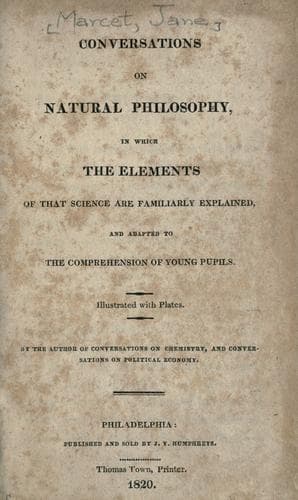
Conversations on Natural Philosophy, in which the Elements of that Science are Familiarly ExplainedMarcet, Mrs. (Jane Haldimand)
Science
Conversations on Natural Philosophy, in which the Elements of that Science are Familiarly Explained
Marcet, Mrs. (Jane Haldimand)
Physics
_Caroline._ They do fall to the ground, certainly, when it rains; but,
according to your theory, I should have imagined, that when the clouds
became too heavy, for the region of air in which they were situated, to
support them, they would descend, till they reached a stratum of air of
their own weight, and not fall to the earth; for as clouds are formed of
vapour, they cannot be so heavy as the lowest regions of the atmosphere,
otherwise the vapour would not have risen.
_Mrs. B._ If you examine the manner in which the clouds descend, it will
obviate this objection. In falling, several of the watery particles
come within the sphere of each other's attraction, and unite in the form
of a drop of water. The vapour thus transformed into a shower, is
heavier than any part of the atmosphere, and consequently descends to
the earth.
_Caroline._ How wonderfully curious!
_Mrs. B._ It is impossible to consider any part of nature attentively,
without being struck with admiration at the wisdom it displays; and I
hope you will never contemplate these wonders, without feeling your
heart glow with admiration and gratitude, towards their bounteous
Author. Observe, that if the waters were never drawn out of the earth,
all vegetation would be destroyed by the excess of moisture; if, on the
other hand, the plants were not nourished and refreshed by occasional
showers, the drought would be equally fatal to them. If the clouds
constantly remained in a state of vapour, they might, as you remarked,
descend into a heavier stratum of the atmosphere, but could never fall
to the ground; or were the power of attraction more than sufficient to
convert the vapour into drops, it would transform the cloud into a mass
of water, which, instead of nourishing, would destroy the produce of the
earth.
Water then ascends in the form of vapour, and descends in that of rain,
snow, or hail, all of which ultimately become water. Some of this falls
into the various bodies of water on the surface of the globe, the
remainder upon the land. Of the latter, part reascends in the form of
vapour, part is absorbed by the roots of vegetables, and part descends
into the earth, where it forms springs.
_Emily._ Is there then no difference between rain water, and spring
water?
_Mrs. B._ They are originally the same; but that portion of rain water
which goes to supply springs, dissolves a number of foreign particles,
which it meets with in its passage through the various soils it
traverses.
_Caroline._ Yet spring water is more pleasant to the taste, appears more
transparent, and, I should have supposed, would have been more pure than
rain water.
Public-domain text, read in full here on John Shaqi.
Reviews
Reviews
No reviews yet
Be the first to share your thoughts on this work.
Elsewhere in the archive
Join the Discussion
Join the discussion
Sign in to leave a comment or review.
Sign InorCreate an account