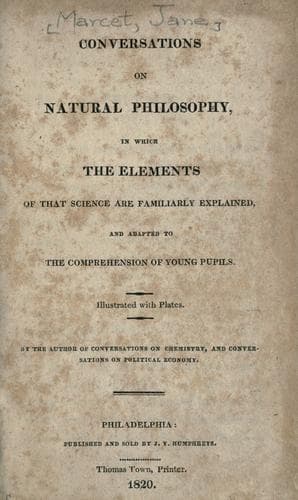
Conversations on Natural Philosophy, in which the Elements of that Science are Familiarly ExplainedMarcet, Mrs. (Jane Haldimand)
Science
Conversations on Natural Philosophy, in which the Elements of that Science are Familiarly Explained
Marcet, Mrs. (Jane Haldimand)
Physics
_Mrs. B._ Friction, (as we observed in a former lesson,) may be
diminished by polishing, but can never be entirely destroyed; and though
fluids, are less susceptible of friction, than solid bodies, they are
still affected by it. Another reason why a fountain will not rise so
high as its reservoir, is, that as all the water which spouts up, has to
descend again, it in doing so, presses, or strikes against the under
parts, and forces them sideways, spreading the column into a head, and
rendering it both wider, and shorter, than it otherwise would be.
At our next meeting, we shall examine the mechanical properties of the
air, which being an elastic fluid, differs in many respects, from
liquids.
Questions
1. (Pg. 129) Why do not the frequent rains, fill the earth with water?
2. (Pg. 129) Why will vapour rise? to what height will it ascend, and
what will it form?
3. (Pg. 129) How may drops of rain be formed?
4. (Pg. 130) What becomes of the water after it has fallen to the earth?
5. (Pg. 130) What is the difference between rain water, and that from
springs?
6. (Pg. 130) Why is rain more pure than spring water?
7. (Pg. 130) Why is spring water more agreeable to the palate?
8. (Pg. 131) What causes the water to collect and form springs?
9. (Pg. 131) Why cannot water penetrate through clay?
10. (Pg. 131) What is represented by fig. 9, plate 13?
11. (Pg. 132) How can you account for its rising upwards, as represented
at C?
12. (Pg. 132) In conveying water by means of pipes, how must the
reservoir be situated?
13. (Pg. 132) What is the instrument called, which is represented in
plate 14, fig. 1,--and how does it operate?
14. (Pg. 133) Why are wells rarely well supplied with water, in elevated
situations?
15. (Pg. 133) When water is found in elevated situations, whence is it
supplied?
16. (Pg. 133) Wells and springs, at some periods well supplied, fail at
others; how is this accounted for?
17. (Pg. 134) Some springs flow abundantly in dry weather, which
occasionally fail in wet weather, how may this be explained?
18. (Pg. 134) What is meant by intermitting springs?
19. (Pg. 134) Whence do rivers, in general, derive their water?
20. (Pg. 134) Why do springs abound more in mountainous, than in level
countries?
21. (Pg. 135) How are lakes formed?
22. (Pg. 135) What causes water to rise in fountains, and how is this
explained by figure 2, plate 14?
23. (Pg. 135) Why will not the fountain rise to the height of the water
in the reservoir?
CONVERSATION XII.
ON THE MECHANICAL PROPERTIES OF AIR.
OF THE SPRING OR ELASTICITY OF THE AIR. OF THE WEIGHT OF THE AIR.
EXPERIMENTS WITH THE AIR PUMP. OF THE BAROMETER. MODE OF WEIGHING AIR.
SPECIFIC GRAVITY OF AIR. OF PUMPS. DESCRIPTION OF THE SUCKING PUMP.
DESCRIPTION OF THE FORCING PUMP.
MRS. B.
At our last meeting we examined the properties of fluids in general, and
more particularly of such as are called non-elastic fluids, or liquids.
Public-domain text, read in full here on John Shaqi.
Reviews
Reviews
No reviews yet
Be the first to share your thoughts on this work.
Elsewhere in the archive
Join the Discussion
Join the discussion
Sign in to leave a comment or review.
Sign InorCreate an account