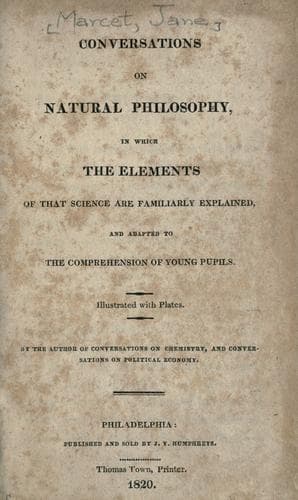
Conversations on Natural Philosophy, in which the Elements of that Science are Familiarly ExplainedMarcet, Mrs. (Jane Haldimand)
Science
Conversations on Natural Philosophy, in which the Elements of that Science are Familiarly Explained
Marcet, Mrs. (Jane Haldimand)
Physics
There is another class of fluids, distinguished by the name of æriform,
or elastic fluids, the principal of which is the air we breathe, which
surrounds the earth, and is called the atmosphere.
_Emily._ There are then other kinds of air, besides the atmosphere?
_Mrs. B._ Yes; a great variety; but they differ only in their chemical,
and not in their mechanical properties; and as it is the latter we are
to examine, we shall not at present inquire into their composition, but
confine our attention to the mechanical properties of elastic fluids in
general.
_Caroline._ And from whence arises this difference, between elastic, and
non-elastic fluids?
_Mrs. B._ There is no attraction of cohesion, between the particles of
elastic fluids; so that the expansive power of heat, has no adversary to
contend with, but gravity; any increase of temperature, therefore,
expands elastic fluids considerably, and a diminution, proportionally
condenses them.
The most essential point, in which air, differs from other fluids is in
its spring or elasticity; that is to say, its power of increasing, or
diminishing in bulk, accordingly as it is more, or less, compressed: a
power of which I have informed you, liquids are almost wholly deprived.
_Emily._ I think I understand the elasticity of the air very well from
what you formerly said of it; but what perplexes me is, its having
gravity; if it is heavy, and we are surrounded by it, why do we not feel
its weight?
_Caroline._ It must be impossible to be sensible of the weight of such
infinitely small particles, as those of which the air is composed:
particles which are too small to be seen, must be too light to be felt.
_Mrs. B._ You are mistaken, my dear; the air is much heavier than you
imagine; it is true, that the particles which compose it, are small; but
then, reflect on their quantity: the atmosphere extends in height, a
great number of miles from the earth, and its gravity is such, that a
man of middling stature, is computed (when the air is heaviest) to
sustain the weight of about 14 tons.
_Caroline._ Is it possible! I should have thought such a weight would
have crushed any one to atoms.
_Mrs. B._ That would, indeed, be the case, if it were not for the
equality of the pressure, on every part of the body; but when thus
diffused, we can bear even a much greater weight, without any
considerable inconvenience. In bathing we support the weight and
pressure of the water, in addition to that of the atmosphere; but
because this pressure is equally distributed over the body, we are
scarcely sensible of it; whilst if your shoulders, your head, or any
particular part of your frame, were loaded with the additional weight of
a hundred pounds, you would soon sink under the fatigue. Besides this,
our bodies contain air, the spring of which, counterbalances the weight
of the external air, and renders us insensible of its pressure.
Public-domain text, read in full here on John Shaqi.
Reviews
Reviews
No reviews yet
Be the first to share your thoughts on this work.
Elsewhere in the archive
Join the Discussion
Join the discussion
Sign in to leave a comment or review.
Sign InorCreate an account