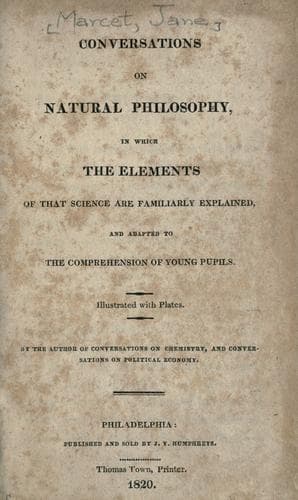
Conversations on Natural Philosophy, in which the Elements of that Science are Familiarly ExplainedMarcet, Mrs. (Jane Haldimand)
Science
Conversations on Natural Philosophy, in which the Elements of that Science are Familiarly Explained
Marcet, Mrs. (Jane Haldimand)
Physics
_Mrs. B._ That weight, you see, is almost two grains. The dimensions of
this bottle, are six cubic inches. Six cubic inches of air, therefore,
at the temperature of this room, weighs nearly 2 grains.
_Caroline._ Why do you observe the temperature of the room, in
estimating the weight of the air?
_Mrs. B._ Because heat rarefies air, and renders it lighter; therefore
the warmer the air is, which you weigh, the lighter it will be.
If you should now be desirous of knowing the specific gravity of this
air, we need only fill the same bottle, with water, and thus obtain the
weight of an equal quantity of water--which you see is 1515 grs.; now by
comparing the weight of water, to that of air, we find it to be in the
proportion of about 800 to 1.
As you are acquainted with decimal arithmetic, you will understand what
I mean, when I tell you, that water being called 1000, the specific
gravity of air, will be 1.2.
I will show you another instance, of the weight of the atmosphere, which
I think will please you: you know what a barometer is?
_Caroline._ It is an instrument which indicates the state of the
weather, by means of a tube of quicksilver; but how, I cannot exactly
say.
_Mrs. B._ It is by showing the weight of the atmosphere, which has great
influence on the weather. The barometer, is an instrument extremely
simple in its construction. In order that you may understand it, I will
show you how it is made. I first fill with mercury, a glass tube A B,
(fig. 3, plate 14.) about three feet in length, and open only at one
end; then stopping the open end, with my finger, I immerse it in a cup
C, containing a little mercury.
_Emily._ Part of the mercury which was in the tube, I observe, runs down
into the cup; but why does not the whole of it subside, for it is
contrary to the law of the equilibrium of fluids, that the mercury in
the tube, should not descend to a level with that in the cup?
_Mrs. B._ The mercury that has fallen from the tube, into the cup, has
left a vacant space in the upper part of the tube, to which the air
cannot gain access; this space is therefore a perfect vacuum; the
mercury in the tube, is relieved from the pressure of the atmosphere,
whilst that in the cup, remains exposed to it.
_Caroline._ Oh, now I understand it; the pressure of the air on the
mercury in the cup, forces it to rise in the tube, where there is not
any air to counteract the external pressure.
_Emily._ Or rather supports the mercury in the tube, and prevents it
from falling.
_Mrs. B._ That comes to the same thing; for the power that can support
mercury in a vacuum, would also make it ascend, when it met with a
vacuum.
Thus you see, that the equilibrium of the mercury is destroyed, only to
preserve the general equilibrium of fluids.
_Caroline._ But this simple apparatus is, in appearance, very unlike a
barometer.
Public-domain text, read in full here on John Shaqi.
Reviews
Reviews
No reviews yet
Be the first to share your thoughts on this work.
Elsewhere in the archive
Join the Discussion
Join the discussion
Sign in to leave a comment or review.
Sign InorCreate an account