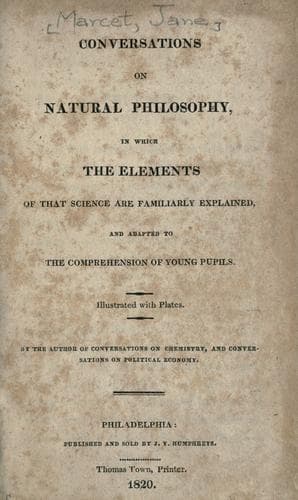
Conversations on Natural Philosophy, in which the Elements of that Science are Familiarly ExplainedMarcet, Mrs. (Jane Haldimand)
Science
Conversations on Natural Philosophy, in which the Elements of that Science are Familiarly Explained
Marcet, Mrs. (Jane Haldimand)
Physics
_Mrs. B._ It is all that is essential to a barometer. The tube and the
cup, or a cistern of mercury, are fixed on a board, for the convenience
of suspending it; the brass plate on the upper part of the board, is
graduated into inches, and tenths of inches, for the purpose of
ascertaining the height at which the mercury stands in the tube; and the
small moveable metal plate, serves to show that height, with greater
accuracy.
_Emily._ And at what height, will the weight of the atmosphere sustain
the mercury?
_Mrs. B._ About 28 or 29 inches, as you will see by this barometer; but
it depends upon the weight of the atmosphere, which varies much, in
different states of the weather. The greater the pressure of the air on
the mercury in the cup, the higher it will ascend in the tube. Now can
you tell me whether the air is heavier, in wet, or in dry weather?
_Caroline._ Without a moment's reflection, the air must be heaviest in
wet weather. It is so depressing, and makes one feel so heavy, while in
fine weather, I feel as light as a feather, and as brisk as a bee.
_Mrs. B._ Would it not have been better to have answered with a moment's
reflection, Caroline? It would have convinced you, that the air must be
heaviest in dry weather; for it is then, that the mercury is found to
rise in the tube, and consequently, the mercury in the cup, must be most
pressed by the air.
_Caroline._ Why then does the air feel so heavy, in bad weather?
_Mrs. B._ Because it is less salubrious, when impregnated with damp. The
lungs, under these circumstances, do not play so freely, nor does the
blood circulate so well; thus obstructions are frequently occasioned in
the smaller vessels, from which arise colds, asthmas, agues, fevers, &c.
_Emily._ Since the atmosphere diminishes in density, in the upper
regions, is not the air more rare, upon a hill, than in a plain; and
does the barometer indicate this difference?
_Mrs. B._ Certainly. This instrument, is so exact in its indications,
that it is used for the purpose of measuring the height of mountains,
and of estimating the elevation of balloons; the mercury descending in
the tube, as you ascend to a greater height.
_Emily._ And is no inconvenience experienced, from the thinness of the
air, in such elevated situations?
_Mrs. B._ Oh, yes; frequently. It is sometimes oppressive, from being
insufficient for respiration; and the expansion which takes place, in
the more dense air contained within the body, is often painful: it
occasions distention, and sometimes causes the bursting of the smaller
blood-vessels, in the nose, and ears. Besides in such situations, you
are more exposed, both to heat, and cold; for though the atmosphere is
itself transparent, its lower regions, abound with vapours, and
exhalations, from the earth, which float in it, and act in some degree
as a covering, which preserves us equally from the intensity of the
sun's rays, and from the severity of the cold.
Public-domain text, read in full here on John Shaqi.
Reviews
Reviews
No reviews yet
Be the first to share your thoughts on this work.
Elsewhere in the archive
Join the Discussion
Join the discussion
Sign in to leave a comment or review.
Sign InorCreate an account