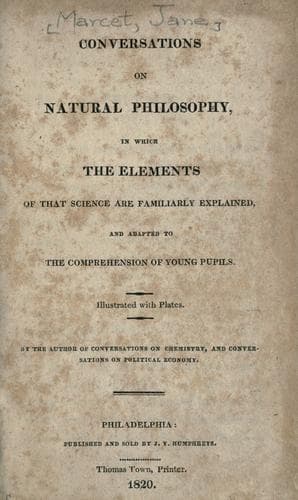
Conversations on Natural Philosophy, in which the Elements of that Science are Familiarly ExplainedMarcet, Mrs. (Jane Haldimand)
Science
Conversations on Natural Philosophy, in which the Elements of that Science are Familiarly Explained
Marcet, Mrs. (Jane Haldimand)
Physics
_Caroline._ The air from the west, then, constantly goes to meet the
sun, and repair the disturbance which his beams have produced in the
equilibrium of the atmosphere. But I wonder how you will reconcile these
various winds, Mrs. B.; you first led me to suppose there was a constant
struggle between opposite winds at the equator, producing storm and
tempest; but now I hear of one regular invariable wind, which must
naturally be attended by calm weather.
_Emily._ I think I comprehend it: do not these winds from the north and
south, combine with the easterly wind about the equator, and form, what
are called, the trade-winds?
_Mrs. B._ Just so, my dear. The composition of the two winds, north and
east, produces a constant north-east wind; and that of the two winds,
south and east, produces a regular south-east wind; these winds extend
to about thirty degrees on each side of the equator, the regions further
distant from it, experiencing only their respective northerly and
southerly winds.
_Caroline._ But, Mrs. B., if the air is constantly flowing from the
poles, to the torrid zone, there must be a deficiency of air, in the
polar regions?
_Mrs. B._ The light air about the equator, which expands, and rises into
the upper regions of the atmosphere, ultimately flows from thence, back
to the poles, to restore the equilibrium: if it were not for this
resource, the polar, atmospheric regions, would soon be exhausted by the
stream of air, which, in the lower strata of the atmosphere, they are
constantly sending towards the equator.
_Caroline._ There is then a sort of circulation of air in the
atmosphere; the air in the lower strata, flowing from the poles towards
the equator, and in the upper strata, flowing back from the equator,
towards the poles.
_Mrs. B._ Exactly; I can show you an example of this circulation, on a
smaller scale. The air of this room, being more rarefied, than the
external air, a wind or current of air is pouring in from the crevices
of the windows and doors, to restore the equilibrium; but the light air,
with which the room is filled, must find some vent, in order to make way
for the heavy air that enters. If you set the door a-jar, and hold a
candle near the upper part of it, you will find that the flame will be
blown outwards, showing that there is a current of air flowing out from
the upper part of the room.--Now place the candle on the floor, close by
the door, and you will perceive, by the inclination of the flame, that
there is also a current of air, setting into the room.
_Caroline._ It is just so; the upper current is the warm light air,
which is driven out to make way for the stream of cold dense air, which
enters the room lower down.
_Mrs. B._ Besides the general, or trade-winds, there are others, which
are called periodical, because they blow in contrary directions, at
particular periods.
Public-domain text, read in full here on John Shaqi.
Reviews
Reviews
No reviews yet
Be the first to share your thoughts on this work.
Elsewhere in the archive
Join the Discussion
Join the discussion
Sign in to leave a comment or review.
Sign InorCreate an account