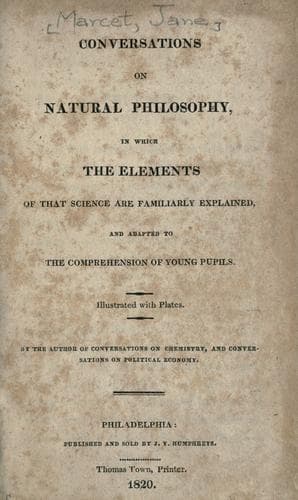
Conversations on Natural Philosophy, in which the Elements of that Science are Familiarly ExplainedMarcet, Mrs. (Jane Haldimand)
Science
Conversations on Natural Philosophy, in which the Elements of that Science are Familiarly Explained
Marcet, Mrs. (Jane Haldimand)
Physics
_Emily._ I have heard, Mrs. B., that the periodical winds, called, in
the torrid zone, the sea and land breezes, blow towards the land, in the
day time, and towards the sea, at night: what is the reason of that?
_Mrs. B._ The land reflects into the atmosphere, a much greater quantity
of the sun's rays, than the water; therefore, that part of the
atmosphere which is over the land, is more heated and rarefied, than
that which is over the sea: this occasions the wind to set in upon the
land, as we find that it regularly does on the coast of Guinea, and
other countries in the torrid zone. There, they have only the sea
breeze, but on the islands, they have, in general, both a land and sea
breeze, the latter being produced in the way described; whilst at night,
during the absence of the sun, the earth cools, and the air is
consequently condensed, and flows from the land, towards the sea,
occasioning the land breeze.
_Emily._ I have heard much of the violent tempests, occasioned by the
breaking up of the monsoons; are not they also regular trade-winds?
_Mrs. B._ They are called periodical trade-winds, as they change their
course every half year. This variation is produced by the earth's
annual course round the sun; the north pole being inclined towards that
luminary one half of the year, the south pole, the other half. During
the summer of the northern hemisphere, the countries of Arabia, Persia,
India, and China, are much heated, and reflect great quantities of the
sun's rays into the atmosphere, by which it becomes extremely rarefied,
and the equilibrium consequently destroyed. In order to restore it, the
air from the equatorial southern regions, where it is colder, (as well
as from the colder northern parts,) must necessarily have a motion
towards those parts. The current of air from the equatorial regions,
produces the trade-winds for the first six months, in all the seas
between the heated continent of Asia, and the equator. The other six
months, when it is summer in the southern hemisphere, the ocean and
countries towards the southern tropic are most heated, and the air over
those parts, more rarefied: then the air about the equator alters its
course, and flows exactly in an opposite direction.
_Caroline._ This explanation of the monsoons is very curious; but what
does their breaking up mean?
_Mrs. B._ It is the name given by sailors to the shifting of the
periodical winds; they do not change their course suddenly, but by
degrees, as the sun moves from one hemisphere, to the other: this change
is usually attended by storms and hurricanes, very dangerous for
shipping; so that those seas are seldom navigated at the season of the
equinoxes.
_Emily._ I think I understand the winds in the torrid zone perfectly
well; but what is it that occasions the great variety of winds, which
occur in the temperate zones? for, according to your theory, there
should be only north and south winds, in those climates.
Public-domain text, read in full here on John Shaqi.
Reviews
Reviews
No reviews yet
Be the first to share your thoughts on this work.
Elsewhere in the archive
Join the Discussion
Join the discussion
Sign in to leave a comment or review.
Sign InorCreate an account