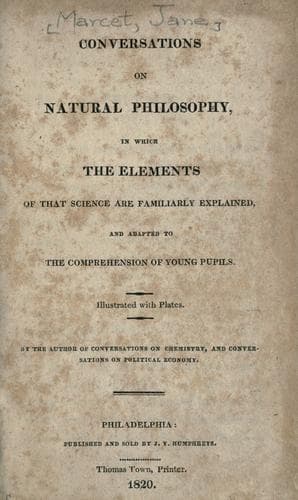
Conversations on Natural Philosophy, in which the Elements of that Science are Familiarly ExplainedMarcet, Mrs. (Jane Haldimand)
Science
Conversations on Natural Philosophy, in which the Elements of that Science are Familiarly Explained
Marcet, Mrs. (Jane Haldimand)
Physics
_Mrs. B._ Since so large a portion of the atmosphere, as is over the
torrid zone, is in continued agitation, these agitations in an elastic
fluid, which yields to the slightest impression, must extend every way,
to a great distance; the air, therefore, in all climates, will suffer
more or less perturbation, according to the situation of the country,
the position of mountains, valleys, and a variety of other causes: hence
it is easy to conceive, that almost every climate, must be liable to
variable winds; this is particularly the case in high latitudes, where
the earth is less powerfully affected by the sun's rays, than near the
equator.
_Caroline._ I have observed, that the wind, whichever way it blows,
almost always falls about sun-set.
_Mrs. B._ Because the rarefaction of air in the particular spot which
produces the wind, diminishes as the sun declines, and consequently the
velocity of the wind, abates.
_Emily._ Since the air is a gravitating fluid, is it not affected by the
attraction of the moon and the sun, in the same manner as the waters?
_Mrs. B._ Undoubtedly; but the ærial tides are as much greater than
those of water, as the density of water exceeds that of air, which, as
you may recollect, we found to be about 800 to 1.
_Caroline._ What a prodigious protuberance that must occasion! How much
the weight of such a column of air, must raise the mercury in the
barometer!
_Emily._ As this enormous tide of air is drawn up and supported, as it
were, by the moon, its weight and pressure, I should suppose, would be
rather diminished than increased?
_Mrs. B._ The weight of the atmosphere is neither increased nor
diminished by the ærial tides. The moon's attraction augments the bulk,
as much as it diminishes the weight, of the column of air; these
effects, therefore, counterbalancing each other, the ærial tides do not
affect the barometer.
_Caroline._ I do not quite understand that.
_Mrs. B._ Let us suppose that the additional bulk of air at high tide,
raises the barometer one inch; and on the other hand, that the support
which the moon's attraction affords the air, diminishes its weight or
pressure, so as to occasion the mercury to fall one inch; under these
circumstances the mercury must remain stationary. Thus, you see, that we
can never be sensible of ærial tides by the barometer, on account of the
equality of pressure of the atmosphere, whatever be its height.
The existence of ærial tides is not, however, hypothetical; it is proved
by the effect they produce on the apparent position of the heavenly
bodies; but this I cannot explain to you, till you understand the
properties of light.
_Emily._ And when shall we learn them?
_Mrs. B._ I shall first explain to you the nature of sound, which is
intimately connected with that of air; and I think at our next meeting,
we may enter upon the subject of optics.
Public-domain text, read in full here on John Shaqi.
Reviews
Reviews
No reviews yet
Be the first to share your thoughts on this work.
Elsewhere in the archive
Join the Discussion
Join the discussion
Sign in to leave a comment or review.
Sign InorCreate an account