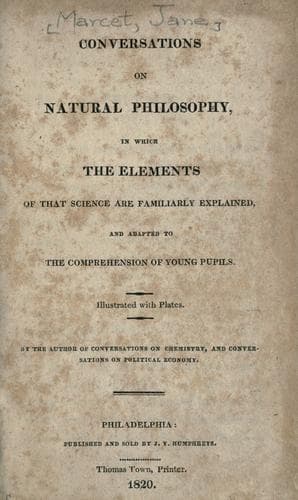
Conversations on Natural Philosophy, in which the Elements of that Science are Familiarly ExplainedMarcet, Mrs. (Jane Haldimand)
Science
Conversations on Natural Philosophy, in which the Elements of that Science are Familiarly Explained
Marcet, Mrs. (Jane Haldimand)
Physics
_Mrs. B._ Not absolutely necessary, though by far the most common
vehicle of sound. Liquids, as well as air, are capable of conveying the
vibratory motion of a sonorous body, to the organ of hearing; as sound
can be heard under water. Solid bodies also, convey sound, as I can soon
convince you by a very simple experiment. I shall fasten this string by
the middle, round the poker; now raise the poker from the ground, by the
two ends of the string, and hold one to each of your ears:--I shall now
strike the poker, with a key, and you will find that the sound is
conveyed to the ear by means of the strings, in a much more perfect
manner, than if it had no other vehicle than the air.
_Caroline._ That it is, certainly, for I am almost stunned by the noise.
But what is a sonorous body, Mrs. B.? for all bodies are capable of
producing some kind of sound, by the motion they communicate to the air.
_Mrs. B._ Those bodies are called sonorous, which produce clear,
distinct, regular, and durable sounds, such as a bell, a drum, musical
strings, wind instruments, &c. They owe this property to their
elasticity; for an elastic body, after having been struck, not only
returns to its former situation, but having acquired momentum by its
velocity, like the pendulum, it springs out on the opposite side. If I
draw the string A B, (fig. 6, plate 14,) which is made fast at both
ends, to C, it will not only return to its original position, but
proceed onwards, to D.
This is its first vibration; at the end of which, it will retain
sufficient velocity to bring it to E, and back again to F, which
constitutes its second vibration; the third vibration, will carry it
only to G and H, and so on, till the resistance of the air destroys its
motion.
The vibration of a sonorous body, gives a tremulous motion to the air
around it, very similar to the motion communicated to smooth water, when
a stone is thrown into it. This, first produces a small circular wave,
around the spot in which the stone falls; the wave spreads, and
gradually communicates its motion to the adjacent waters, producing
similar waves to a considerable extent. The same kind of waves are
produced in the air, by the motion of a sonorous body, but with this
difference, that as air, is an elastic fluid, the motion does not
consist of regularly extending waves, but of vibrations; and are
composed of a motion, forwards and backwards, similar to those of the
sonorous body. They differ also, in the one taking place in a plane,
the other, in all directions: the ærial undulations, being spherical.
_Emily._ But if the air moves backwards, as well as forwards, how can
its motion extend so as to convey sound to a distance?
Public-domain text, read in full here on John Shaqi.
Reviews
Reviews
No reviews yet
Be the first to share your thoughts on this work.
Elsewhere in the archive
Join the Discussion
Join the discussion
Sign in to leave a comment or review.
Sign InorCreate an account