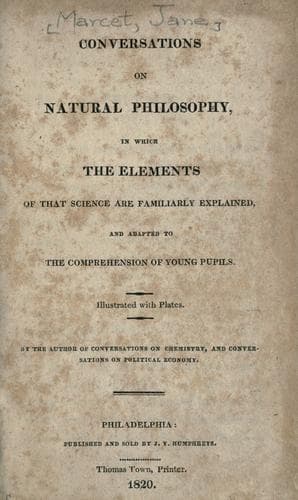
Conversations on Natural Philosophy, in which the Elements of that Science are Familiarly ExplainedMarcet, Mrs. (Jane Haldimand)
Science
Conversations on Natural Philosophy, in which the Elements of that Science are Familiarly Explained
Marcet, Mrs. (Jane Haldimand)
Physics
_Mrs. B._ The first sphere of undulations, which are produced
immediately around the sonorous body, by pressing against the contiguous
air, condenses it. The condensed air, though impelled forward by the
pressure, reacts on the first set of undulations, driving them back
again. The second set of undulations which have been put in motion, in
their turn, communicate their motion, and are themselves driven back, by
reaction. Thus, there is a succession of waves in the air, corresponding
with the succession of waves in the water.
_Caroline._ The vibrations of sound, must extend much further than the
circular waves in water, since sound is conveyed to a great distance.
_Mrs. B._ The air is a fluid so much less dense than water, that motion
is more easily communicated to it. The report of a cannon produces
vibrations of the air, which extend to several miles around.
_Emily._ Distant sound takes some time to reach us, since it is produced
at the moment the cannon is fired; and we see the light of the flash,
long before we hear the report.
_Mrs. B._ The air is immediately put in motion, by the firing of a
cannon; but it requires time for the vibrations to extend to any distant
spot. The velocity of sound, is computed to be at the rate of 1142 feet
in a second.
_Caroline._ With what astonishing rapidity the vibrations must be
communicated! But the velocity of sound varies, I suppose, with that of
the air which conveys it. If the wind sets towards us from the cannon,
we must hear the report sooner than if it set the other way.
_Mrs. B._ The direction of the wind makes less difference in the
velocity of sound, than you would imagine. If the wind sets from us, it
bears most of the ærial waves away, and renders the sound fainter; but
it is not very considerably longer in reaching the ear, than if the wind
blew towards us. This uniform velocity of sound, enables us to determine
the distance of the object, from which it proceeds; as that of a vessel
at sea, firing a cannon, or that of a thunder cloud. If we do not hear
the thunder, till half a minute after we see the lightning, we conclude
the cloud to be at the distance of six miles and a half.
_Emily._ Pray, how is the sound of an echo produced?
_Mrs. B._ When the ærial vibrations meet with an obstacle, having a hard
and regular surface, such as a wall, or rock, they are reflected back to
the ear, and produce the same sound a second time; but the sound will
then appear to proceed, from the object by which it is reflected. If the
vibrations fall perpendicularly on the obstacle, they are reflected back
in the same line; if obliquely, the sound returns obliquely, in the
opposite direction, the angle of reflection being equal to the angle of
incidence.
Public-domain text, read in full here on John Shaqi.
Reviews
Reviews
No reviews yet
Be the first to share your thoughts on this work.
Elsewhere in the archive
Join the Discussion
Join the discussion
Sign in to leave a comment or review.
Sign InorCreate an account