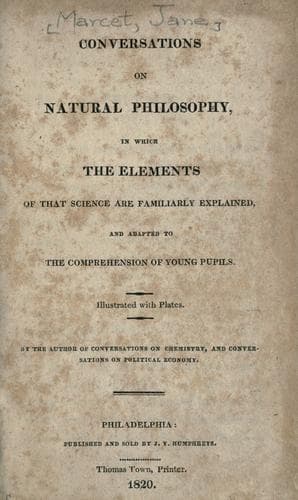
Conversations on Natural Philosophy, in which the Elements of that Science are Familiarly ExplainedMarcet, Mrs. (Jane Haldimand)
Science
Conversations on Natural Philosophy, in which the Elements of that Science are Familiarly Explained
Marcet, Mrs. (Jane Haldimand)
Physics
_Caroline._ When I want to see an object above me, I look up; when an
object below me, I look down. Does not this prove that I see the objects
themselves? for if I beheld only the image, there would be no necessity
for looking up or down, according as the object was higher or lower,
than myself.
_Mrs. B._ I beg your pardon. When you look up, to an elevated object, it
is in order that the rays reflected from it, should fall upon the retina
of your eyes; but the very circumstance of directing your eyes upwards,
convinces you that the object is elevated, and teaches you to consider
as uppermost, the image it forms on the retina, though it is, in fact,
represented in the lowest part of it. When you look down upon an object,
you draw your conclusion from a similar reasoning; it is thus that we
see all objects in the direction of the rays which reach our eyes.
But I have a further proof in favour of what I have advanced, which, I
hope, will remove your remaining doubts: I shall, however, defer it till
our next meeting, as the lesson has been sufficiently long to-day.
Questions
1. (Pg. 157) What is optics?
2. (Pg. 157) What is meant by a luminous body?
3. (Pg. 157) What is meant by a dark body, and what by an opaque body?
4. (Pg. 157) What are transparent bodies?
5. (Pg. 157) What is a medium?
6. (Pg. 158) How is light projected from luminous bodies, and how, from
every point of such bodies, (fig. 1, plate 15?)
7. (Pg. 158) Why do not the rays of light from different points, stop
each other's progress?
8. (Pg. 158) What is a ray, and what a pencil of rays? fig. 2, plate 15.
9. (Pg. 158) Do we know whether light is a substance, similar to bodies
in general?
10. (Pg. 158) When a ray of light falls upon an opaque body, what is the
result?
11. (Pg. 159) In what does shadow consist?
12. (Pg. 159) Why are they, in general, but partially dark?
13. (Pg. 159) Upon what does the intensity of a shadow depend?
14. (Pg. 159) How are shadows affected by the size of the luminous body,
as represented in plate 15, fig. 3?
15. (Pg. 159) When is the shadow larger than the intercepting body?
16. (Pg. 160) What is explained by fig. 4, plate 15?
17. (Pg. 160) What will be the effect of several lights, as in fig. 5,
plate 15?
18. (Pg. 160) Why will neither of these shadows be very dark?
19. (Pg. 160) What becomes of the light which falls upon an opaque body?
20. (Pg. 160) What is meant by reflection?
21. (Pg. 161) What is meant by the incident, and reflected rays?
22. (Pg. 161) What is the result, when the incident ray falls
perpendicularly, and what, when it falls obliquely?
23. (Pg. 161) What two angles are always equal in this case?
24. (Pg. 161) To what law in mechanics, is this analogous, as
represented in fig. 4, plate 2?
25. (Pg. 161) What is represented by fig. 6, plate 15?
26. (Pg. 161) By what light are we enabled to see opaque, and by what,
luminous bodies?
Public-domain text, read in full here on John Shaqi.
Reviews
Reviews
No reviews yet
Be the first to share your thoughts on this work.
Elsewhere in the archive
Join the Discussion
Join the discussion
Sign in to leave a comment or review.
Sign InorCreate an account