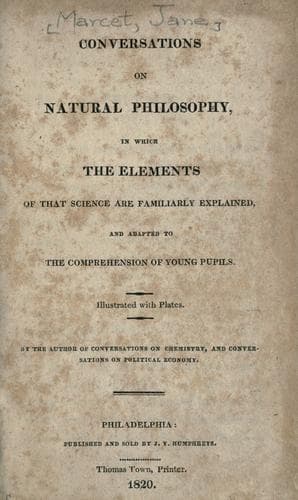
Conversations on Natural Philosophy, in which the Elements of that Science are Familiarly ExplainedMarcet, Mrs. (Jane Haldimand)
Science
Conversations on Natural Philosophy, in which the Elements of that Science are Familiarly Explained
Marcet, Mrs. (Jane Haldimand)
Physics
_Mrs. B._ And I hope to convince you, that the sense of sight, is so
likewise. The nerves, which constitute the sense of sight, are not
different in their nature from those of the other organs; they are
merely instruments which convey ideas to the mind, and can be affected
only on contact. Now, since real objects cannot be brought to touch the
optic nerve, the image of them is conveyed thither by the rays of light,
proceeding from real objects, which actually strike upon the optic
nerve, and form that image which the mind perceives.
_Caroline._ While I listen to your reasoning, I feel convinced; but when
I look upon the objects around, and think that I do not see them, but
merely their image painted in my eyes, my belief is again staggered. I
cannot reconcile to myself, the idea, that I do not really see this book
which I hold in my hand, nor the words which I read in it.
_Mrs. B._ Did it ever occur to you as extraordinary, that you never
beheld your own face?
_Caroline._ No; because I so frequently see an exact representation of
it in the looking-glass.
_Mrs. B._ You see a far more exact representation of objects on the
retina of your eye: it is a much more perfect mirror, than any made by
art.
_Emily._ But is it possible, that the extensive landscape, which I now
behold from the window, should be represented on so small a space, as
the retina of the eye?
_Mrs. B._ It would be impossible for art to paint so small and distinct
a miniature; but nature works with a surer hand, and a more delicate
pencil. That power alone, which forms the feathers of the butterfly, and
the organs of the minutest insect, can pourtray so admirable and
perfect a miniature, as that which is represented on the retina of the
eye.
_Caroline._ But, Mrs. B., if we see only the image of objects, why do we
not see them reversed, as you showed us they were, in the camera
obscura? Is not that a strong argument against your theory?
_Mrs. B._ Not an unanswerable one, I hope. The image on the retina, it
is true, is reversed, like that in the camera obscura; as the rays, from
the different parts of the landscape, intersect each other on entering
the pupil, in the same manner as they do, on entering the camera
obscura. The scene, however, does not excite the idea of being inverted,
because we always see an object in the direction of the rays which it
sends to us.
_Emily._ I confess I do not understand that.
_Mrs. B._ It is, I think, a difficult point to explain clearly. A ray
which comes from the upper part of an object, describes the image on the
lower part of the retina; but, experience having taught us, that the
direction of that ray is from above, we consider that part of the object
it represents as uppermost. The rays proceeding from the lower part of
an object, fall upon the upper part of the retina; but as we know their
direction to be from below, we see that part of the object they describe
as the lowest.
Public-domain text, read in full here on John Shaqi.
Reviews
Reviews
No reviews yet
Be the first to share your thoughts on this work.
Elsewhere in the archive
Join the Discussion
Join the discussion
Sign in to leave a comment or review.
Sign InorCreate an account