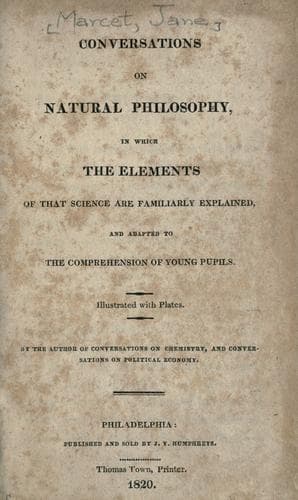
Conversations on Natural Philosophy, in which the Elements of that Science are Familiarly ExplainedMarcet, Mrs. (Jane Haldimand)
Science
Conversations on Natural Philosophy, in which the Elements of that Science are Familiarly Explained
Marcet, Mrs. (Jane Haldimand)
Physics
_Mrs. B._ And yet you can see the whole of it, through one of the
windows of this room. The image of the house on your retina must,
therefore, be smaller than that of the window through which you see it.
It is your knowledge of the real magnitude of the house which prevents
your attending to its apparent size. If you were accustomed to draw from
nature, you would be fully aware of this difference.
_Emily._ And pray, what is the reason that, when we look up an avenue,
the trees not only appear smaller as they are more distant, but seem
gradually to approach each other, till they meet in a point?
_Mrs. B._ Not only the trees, but the road which separates the two rows,
forms a smaller visual angle, in proportion as it is more distant from
us; therefore, the width of the road gradually diminishes, as well as
the size of the trees, till at length the road apparently terminates in
a point, at which the trees seem to meet.
_Emily._ I am very glad to understand this, for I have lately begun to
learn perspective, which appeared to me a very dry study; but now that I
am acquainted with some of the principles on which it is founded, I
shall find it much more interesting.
_Caroline._ In drawing a view from nature, it seems that we do not copy
the real objects, but the image they form on the retina of our eyes?
_Mrs. B._ Certainly. In sculpture, we copy nature as she really exists;
in painting, we represent her, as she appears to us.
We must now conclude the observations that remain to be made, on the
angle of vision.
If the rays, proceeding from the extremities of an object, with an
ordinary degree of illumination, do not enter the eye under an angle of
more than two seconds, which is the 1-1800th part of a degree, it is
invisible. There are, consequently, two cases in which objects may be
invisible; if they are either so small, or so distant, as to form an
angle of less than two seconds of a degree.
In like manner, if the velocity of a body does not exceed 20 degrees in
an hour, its motion is imperceptible.
_Caroline._ A very rapid motion may then be imperceptible, provided the
distance of the moving body, is sufficiently great.
_Mrs. B._ Undoubtedly; for the greater its distance, the smaller will be
the angle, under which its motion will appear to the eye. It is for this
reason, that the motion of the celestial bodies is invisible, although
inconceivably rapid.
_Emily._ I am surprised, that so great a velocity as 20 degrees an hour,
should be invisible.
Public-domain text, read in full here on John Shaqi.
Reviews
Reviews
No reviews yet
Be the first to share your thoughts on this work.
Elsewhere in the archive
Join the Discussion
Join the discussion
Sign in to leave a comment or review.
Sign InorCreate an account