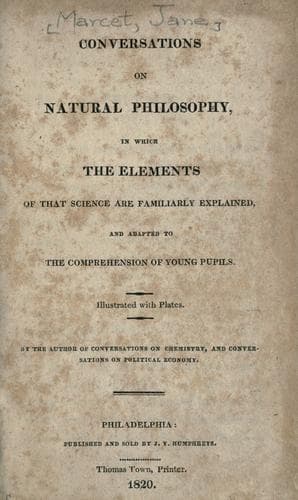
Conversations on Natural Philosophy, in which the Elements of that Science are Familiarly ExplainedMarcet, Mrs. (Jane Haldimand)
Science
Conversations on Natural Philosophy, in which the Elements of that Science are Familiarly Explained
Marcet, Mrs. (Jane Haldimand)
Physics
_Mrs. B._ The real velocity depends upon the space comprehended in each
degree, and upon the time, in which the moving body, passes over that
space. But we can only know the extent of this space, by knowing the
distance of the moving body, from its centre of motion; for supposing
two men to set off at the same moment from A and B, (fig. 2.) to walk
each to the end of their respective lines, C and D; if they perform
their walk in the same space of time, they must have proceeded at a
very different rate; and yet to an eye situated at E, they will appear
to have moved with equal velocity, because they will both have gone
through an equal number of degrees, though over a very unequal length of
ground. The number of degrees over which a body moves in a given time,
is called its angular velocity; two bodies, you see, may have the same
angular, or apparent velocity, whilst their real velocities may differ
almost infinitely. Sight is an extremely useful sense, no doubt, but it
cannot always be relied on, it deceives us both in regard to the size
and the distance of objects; indeed, our senses would be very liable to
lead us into error, if experience did not set us right.
_Emily._ Between the two, I think that we contrive to acquire a
tolerably accurate idea of objects.
_Mrs. B._ At least sufficiently so, for the general purposes of life. To
convince you how requisite experience is, to correct the errors of
sight, I shall relate to you, the case of a young man, who was blind
from his infancy, and who recovered his sight at the age of fourteen, by
the operation of couching. At first, he had no idea, either of the size,
or distance of objects, but imagined that every thing he saw touched his
eyes; and it was not, till after having repeatedly felt them, and walked
from one object to another, that he acquired an idea of their respective
dimensions, their relative situations, and their distances.
_Caroline._ The idea that objects touched his eyes, is, however, not so
absurd, as it at first appears; for if we consider that we see only the
image of objects, this image actually touches our eyes.
_Mrs. B._ That is, doubtless, the reason of the opinion he formed,
before the sense of touch had corrected his judgment.
_Caroline._ But since an image must be formed on the retina of each of
our eyes, why do we not see objects double?
_Mrs. B._ The action of the rays, on the optic nerve of each eye, is so
perfectly similar, that they produce but a single sensation; the mind,
therefore, receives the same idea, from the retina of both eyes, and
conceives the object to be single.
_Caroline._ This is difficult to comprehend, and I should think, can be
but conjectural.
_Mrs. B._ I can easily convince you, that you have a distinct image of
an object formed on the retina of each eye. Look through the window,
with both eyes open, at some object exactly opposite to one of the
upright bars of the sash.
Public-domain text, read in full here on John Shaqi.
Reviews
Reviews
No reviews yet
Be the first to share your thoughts on this work.
Elsewhere in the archive
Join the Discussion
Join the discussion
Sign in to leave a comment or review.
Sign InorCreate an account