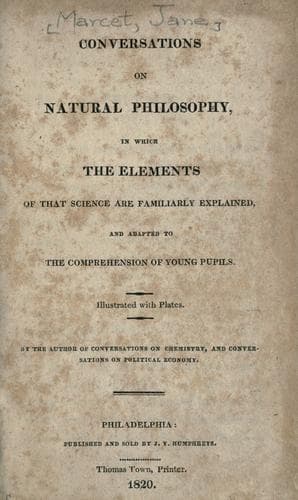
Conversations on Natural Philosophy, in which the Elements of that Science are Familiarly ExplainedMarcet, Mrs. (Jane Haldimand)
Science
Conversations on Natural Philosophy, in which the Elements of that Science are Familiarly Explained
Marcet, Mrs. (Jane Haldimand)
Physics
You may easily conceive the variety of directions in which rays would be
reflected by a nutmeg-grater, on account of the inequality of its
surface, and the number of holes with which it is pierced. All solid
bodies more or less resemble the nutmeg-grater, in these respects; and
it is only those which are susceptible of receiving a polish, that can
be made to reflect the rays with regularity. As hard bodies are of the
closest texture, the least porous, and capable of taking the highest
polish, they make the best mirrors; none, therefore, are so well
calculated for this purpose, as metals.
_Caroline._ But the property of regular reflection, is not confined to
this class of bodies; for I have often seen myself, in a highly polished
mahogany table.
_Mrs. B._ Certainly; but as that substance is less durable, and its
reflection less perfect, than that of metals, I believe it would seldom
be chosen, for the purpose of a mirror.
There are three kinds of mirrors used in optics; the _plain_, or _flat_,
which are the common mirrors we have just mentioned; _convex_ mirrors,
and _concave_ mirrors. The reflection of the two latter, is very
different from that of the former. The plain mirror, we have seen, does
not alter the direction of the reflected rays, and forms an image behind
the glass, exactly similar to the object before it. A convex mirror has
the peculiar property of making the reflected rays diverge, by which
means it diminishes the image; and a concave mirror makes the rays
converge, and under certain circumstances, magnifies the image.
_Emily._ We have a convex mirror in the drawing-room, which forms a
beautiful miniature picture of the objects in the room; and I have often
amused myself with looking at my magnified face in a concave mirror. But
I hope you will explain to us, why the one enlarges, while the other
diminishes the objects it reflects.
_Mrs. B._ Let us begin by examining the reflection of a convex mirror.
This is formed of a portion of the exterior surface of a sphere. When
several parallel rays fall upon it, that ray only which, if prolonged,
would pass through the centre or axis of the mirror, is perpendicular to
it. In order to avoid confusion, I have, in fig. 1, plate 18, drawn only
three parallel lines, A B, C D, E F, to represent rays falling on the
convex mirror, M N; the middle ray, you will observe, is perpendicular
to the mirror, the others fall on it, obliquely.
_Caroline._ As the three rays are parallel, why are they not all
perpendicular to the mirror?
_Mrs. B._ They would be so to a flat mirror; but as this is spherical,
no ray can fall perpendicularly upon it which is not directed towards
the centre of the sphere.
_Emily._ Just as a weight falls perpendicularly to the earth, when
gravity attracts it towards the centre.
Public-domain text, read in full here on John Shaqi.
Reviews
Reviews
No reviews yet
Be the first to share your thoughts on this work.
Elsewhere in the archive
Join the Discussion
Join the discussion
Sign in to leave a comment or review.
Sign InorCreate an account