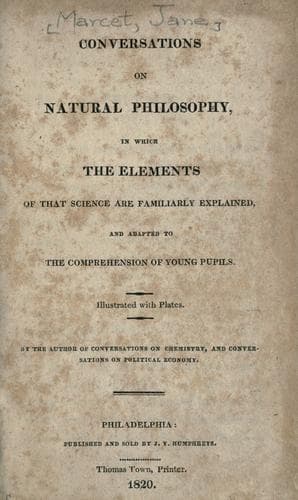
Conversations on Natural Philosophy, in which the Elements of that Science are Familiarly ExplainedMarcet, Mrs. (Jane Haldimand)
Science
Conversations on Natural Philosophy, in which the Elements of that Science are Familiarly Explained
Marcet, Mrs. (Jane Haldimand)
Physics
_Mrs. B._ I beg your pardon, there is; but you cannot see it, because
the incident rays, falling obliquely on the mirror, will be reflected
obliquely, in the opposite direction; the angles of incidence, and
reflection, being equal. Caroline, place yourself in the direction of
the reflected rays, and tell me whether you do not see Emily's image in
the glass?
_Caroline._ Let me consider.--In order to look in the direction of the
reflected rays, I must place myself as much to the left of the glass, as
Emily stands to the right of it.--Now I see her image, not straight
before me, however, but before her; and it appears at the same distance
behind the glass, that she is in front of it.
_Mrs. B._ You must recollect, that we always see objects in the
direction of the last rays, which reach our eyes. Figure 4 represents an
eye, looking at the image of a vase, reflected by a mirror; it must see
it in the direction of the ray A B, as that is the ray which brings the
image to the eye; prolong the ray to C, and in that spot will the image
appear.
_Caroline._ I do not understand why a looking-glass reflects the rays of
light; for glass is a transparent body, which should transmit them!
_Mrs. B._ It is not the glass that reflects the rays which form the
image you behold, but the silvering behind it; this silvering is a
compound of mercury and tin, which forms a brilliant metallic coating.
The glass acts chiefly as a transparent case, through which the rays
find an easy passage, to, and from, the quicksilver.
_Caroline._ Why then should not mirrors be made simply of mercury?
_Mrs. B._ Because mercury is a fluid. By amalgamating it with tinfoil,
it becomes of the consistence of paste, attaches itself to the glass,
and forms, in fact, a metallic mirror, which would be much more perfect
without its glass cover, for the purest glass is never perfectly
transparent; some of the rays, therefore, are lost during their passage
through it, by being either absorbed, or irregularly reflected.
This imperfection of glass mirrors, has introduced the use of metallic
mirrors, for optical purposes.
_Emily._ But since all opaque bodies reflect the rays of light, I do not
understand why they are not all mirrors.
_Caroline._ A curious idea indeed, sister; it would be very gratifying
to see oneself in every object at which one looked.
_Mrs. B._ It is very true that all opaque objects reflect light; but the
surface of bodies, in general, is so rough and uneven, that the
reflection from them is extremely irregular, and prevents the rays from
forming an image on the retina. This, you will be able to understand
better, when I shall explain to you the nature of vision, and the
structure of the eye.
Public-domain text, read in full here on John Shaqi.
Reviews
Reviews
No reviews yet
Be the first to share your thoughts on this work.
Elsewhere in the archive
Join the Discussion
Join the discussion
Sign in to leave a comment or review.
Sign InorCreate an account