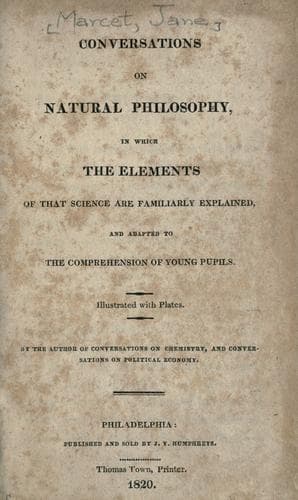
Conversations on Natural Philosophy, in which the Elements of that Science are Familiarly ExplainedMarcet, Mrs. (Jane Haldimand)
Science
Conversations on Natural Philosophy, in which the Elements of that Science are Familiarly Explained
Marcet, Mrs. (Jane Haldimand)
Physics
_Emily._ I have often heard of the surprising effects of burning
mirrors, and I am quite delighted to understand their nature.
_Caroline._ It cannot be the true focus of the mirror, at which the
rays of the sun unite, for as they proceed from so large a body, they
cannot fall upon the mirror parallel to each other.
_Mrs. B._ Strictly speaking, they certainly do not. But when rays, come
from such an immense distance as the sun, they may be considered as
parallel: their point of union is, therefore, the true focus of the
mirror, and there the image of the object is represented.
Now that I have removed the mirror out of the influence of the sun's
rays, if I place a burning taper in the focus, how will its light be
reflected? (Fig. 6.)
_Caroline._ That, I confess, I cannot say.
_Mrs. B._ The ray which falls in the direction of the axis of the
mirror, is reflected back in the same line; but let us draw two other
rays from the focus, falling on the mirror at B and F; the dotted lines
are perpendicular to those points, and the two rays will, therefore, be
reflected to A and E.
_Caroline._ Oh, now I understand it clearly. The rays which proceed from
a light placed in the focus of a concave mirror fall divergent upon it,
and are reflected, parallel. It is exactly the reverse of the former
experiment, in which the sun's rays fell parallel on the mirror, and
were reflected to a focus.
_Mrs. B._ Yes: when the incident rays are parallel, the reflected rays
converge to a focus; when, on the contrary, the incident rays proceed
from the focus, they are reflected parallel. This is an important law of
optics, and since you are now acquainted with the principles on which it
is founded, I hope that you will not forget it.
_Caroline._ I am sure that we shall not. But, Mrs. B., you said that the
image was formed in the focus of a concave mirror; yet I have frequently
seen glass concave mirrors, where the object has been represented within
the mirror, in the same manner as in a convex mirror.
_Mrs. B._ That is the case only, when the object is placed between the
mirror and its focus; the image then appears magnified behind the
mirror, or, as you would say, within it.
_Caroline._ I do not understand why the image should be larger than the
object.
_Mrs. B._ This results from the convergent property of the concave
mirror. If an object, A B, (fig. 7.) be placed between the mirror and
its focus, the rays from its extremities fall divergent on the mirror,
and on being reflected, become less divergent, as if they proceeded from
C: to an eye placed in that situation, the image will appear magnified
behind the mirror at _a b_, since it is seen under a larger angle than
the object.
You now, I hope, understand the reflection of light by opaque bodies. At
our next meeting, we shall enter upon another property of light, no less
interesting, and which is called _refraction_.
Questions
1. (Pg. 168) What is meant by the angle of vision, or the visual angle?
Public-domain text, read in full here on John Shaqi.
Reviews
Reviews
No reviews yet
Be the first to share your thoughts on this work.
Elsewhere in the archive
Join the Discussion
Join the discussion
Sign in to leave a comment or review.
Sign InorCreate an account