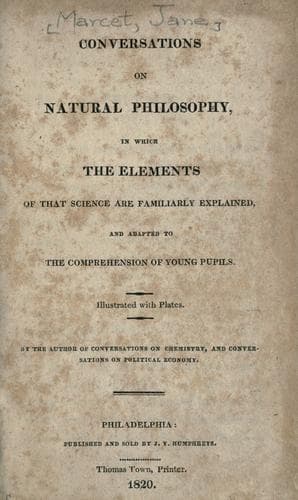
Conversations on Natural Philosophy, in which the Elements of that Science are Familiarly ExplainedMarcet, Mrs. (Jane Haldimand)
Science
Conversations on Natural Philosophy, in which the Elements of that Science are Familiarly Explained
Marcet, Mrs. (Jane Haldimand)
Physics
2. (Pg. 169) Why do objects of the same size appear smaller when
distant, than when near?
3. (Pg. 169) Why do not two objects, known to be equal in size, appear
to differ, when at different distances from the eye?
4. (Pg. 169) How is this exemplified, by a house seen through a window?
5. (Pg. 170) Why do rows of trees, forming an avenue, appear to approach
as they recede from the eye, until they eventually seem to meet?
6. (Pg. 170) In drawing a view from nature, what do we copy?
7. (Pg. 170) What is the difference in sculpture, in this respect?
8. (Pg. 170) Excepting the rays from an object enter the eye, under a
certain angle, they cannot be seen; what must this angle exceed?
9. (Pg. 170) What two circumstances may cause the angle to be so small,
as not to produce vision?
10. (Pg. 170) Motion may be so slow as to become imperceptible, what is
said on this point?
11. (Pg. 170) Under what circumstances may a body, moving with great
rapidity, appear to be at rest?
12. (Pg. 170) Upon what does the real velocity of a body, depend?
13. (Pg. 171) What must be known, to enable us to ascertain the real
space contained in a degree?
14. (Pg. 171) What is explained by fig. 2, plate 17?
15. (Pg. 171) What is said respecting the evidence afforded by our
senses, and how do we correct the errors into which they would lead us?
16. (Pg. 171) An image of a visible object is formed upon the retina of
each eye, why, therefore, are not objects seen double?
17. (Pg. 172) By what experiment can you prove that a separate image of
an object is formed in each eye?
18. (Pg. 172) Under what circumstances are objects seen double?
19. (Pg. 172) Why is not the image of an object inverted in the common
mirror?
20. (Pg. 172) Your whole figure may be seen in a looking-glass, which is
not more than half your height; how is this shown in fig. 3. plate 17?
21. (Pg. 173) Why is the image invisible to the person, when not
standing directly before the glass?
22. (Pg. 173) In what situation may a second person see the image
reflected?
23. (Pg. 173) In what direction will an object always appear to the eye?
24. (Pg. 173) How is this explained by fig. 4, plate 17?
25. (Pg. 173) What is it that reflects the rays in a looking-glass?
26. (Pg. 174) All opaque bodies reflect some light, why do they not all
act as mirrors?
27. (Pg. 174) What substances form the most perfect mirrors, and for
what reason?
28. (Pg. 174) What are the three kinds of mirrors usually employed for
optical purposes?
29. (Pg. 174) How are the rays of light affected by them?
30. (Pg. 175) What is the form of a convex mirror, and how do parallel
rays fall upon it, as represented in fig. 1, plate 18?
31. (Pg. 175) What is represented by the dotted line in the same figure?
32. (Pg. 175) Explain by the figure, how the parallel rays will be
reflected.
33. (Pg. 175) At what distance behind such a mirror, would an image,
produced by parallel rays, be formed?
Public-domain text, read in full here on John Shaqi.
Reviews
Reviews
No reviews yet
Be the first to share your thoughts on this work.
Elsewhere in the archive
Join the Discussion
Join the discussion
Sign in to leave a comment or review.
Sign InorCreate an account