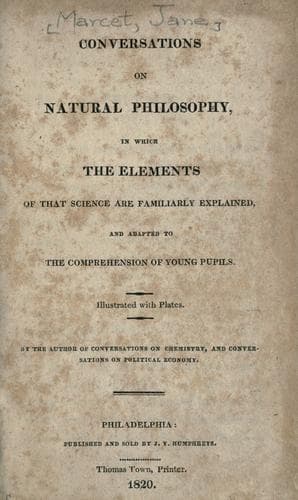
Conversations on Natural Philosophy, in which the Elements of that Science are Familiarly ExplainedMarcet, Mrs. (Jane Haldimand)
Science
Conversations on Natural Philosophy, in which the Elements of that Science are Familiarly Explained
Marcet, Mrs. (Jane Haldimand)
Physics
34. (Pg. 175) What is that point denominated?
35. (Pg. 176) What is meant by a focus?
36. (Pg. 176) Why is the point behind the mirror, called the _imaginary
focus_?
37. (Pg. 176) Why does an object appear to be lessened by a convex
mirror, (fig. 2.)?
38. (Pg. 176) What is a concave mirror, and what its peculiar property?
39. (Pg. 176) How are parallel rays reflected by a concave mirror, as
explained by fig. 3, plate 18?
40. (Pg. 177) Where is the focus of parallel rays, in a concave mirror?
41. (Pg. 177) If rays fall on it convergent, how are they reflected?
42. (Pg. 177) How if divergent?
43. (Pg. 177) How, and why, may concave, become burning mirrors?
44. (Pg. 178) Why may rays of light coming from the sun, be viewed as
parallel to each other?
45. (Pg. 178) If a luminous body, as a burning taper, be placed in the
focus of a concave mirror, how will the rays from it, be reflected?
(fig. 6.)
46. (Pg. 178) What fact is explained by fig. 7, plate 18?
CONVERSATION XVI.
ON REFRACTION AND COLOURS.
TRANSMISSION OF LIGHT BY TRANSPARENT BODIES. REFRACTION. REFRACTION BY
THE ATMOSPHERE. REFRACTION BY A LENS. REFRACTION BY THE PRISM. OF COLOUR
FROM THE RAYS OF LIGHT. OF THE COLOURS OF BODIES.
MRS. B.
The refraction of light will furnish the subject of to-day's lesson.
_Caroline._ That is a property of which I have not the faintest idea.
_Mrs. B._ It is the effect which transparent mediums produce on light in
its passage through them. Opaque bodies, you know, reflect the rays, and
transparent bodies transmit them; but it is found, that _if a ray, in
passing from one medium, into another of different density, fall
obliquely, it is turned out of its course. The ray of light is then said
to be refracted._
_Caroline._ It must then be acted on by some new power, otherwise it
would not deviate from its first direction.
_Mrs. B._ The power which causes the deviation of the ray, appears to be
the attraction of the denser medium. Let us suppose the two mediums to
be air, and water; if a ray of light passes from air, into water, it is
more strongly attracted by the latter, on account of its superior
density.
_Emily._ In what direction does the water attract the ray?
_Mrs. B._ The ray is attracted perpendicularly towards the water, in
the same manner in which bodies are acted upon by gravity.
Public-domain text, read in full here on John Shaqi.
Reviews
Reviews
No reviews yet
Be the first to share your thoughts on this work.
Elsewhere in the archive
Join the Discussion
Join the discussion
Sign in to leave a comment or review.
Sign InorCreate an account