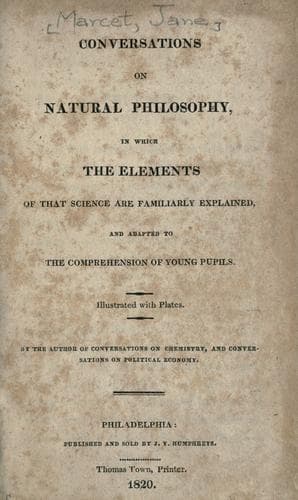
Conversations on Natural Philosophy, in which the Elements of that Science are Familiarly ExplainedMarcet, Mrs. (Jane Haldimand)
Science
Conversations on Natural Philosophy, in which the Elements of that Science are Familiarly Explained
Marcet, Mrs. (Jane Haldimand)
Physics
_Mrs. B._ You must recollect that the sun, is vertical only to the
inhabitants of the torrid zone; its rays, therefore, are always
refracted, in this latitude. There is also another obstacle to our
seeing the heavenly bodies in their real situations: light, though it
moves with extreme velocity, is about eight minutes and a quarter, in
its passage from the sun to the earth; therefore, when the rays reach
us, the sun must have quitted the spot he occupied on their departure;
yet we see him in the direction of those rays, and consequently in a
situation which he had abandoned eight minutes and a quarter, before.
_Emily._ When you speak of the sun's motion, you mean, I suppose, his
apparent motion, produced by the diurnal motion of the earth?
_Mrs. B._ Certainly; the effect being the same, whether it is our earth,
or the heavenly bodies, which move: it is more easy to represent things
as they appear to be, than as they really are.
_Caroline._ During the morning, then, when the sun is rising towards the
meridian, we must (from the length of time the light is in reaching us)
see an image of the sun below that spot which it really occupies.
_Emily._ But the refraction of the atmosphere, counteracting this
effect, we may, perhaps, between the two, see the sun in its real
situation.
_Caroline._ And in the afternoon, when the sun is sinking in the west,
refraction, and the length of time which the light is in reaching the
earth, will conspire to render the image of the sun, higher than it
really is.
_Mrs. B._ The refraction of the sun's rays, by the atmosphere, prolongs
our days, as it occasions our seeing an image of the sun, both before he
rises, and after he sets; when below our horizon, he still shines upon
the atmosphere, and his rays are thence refracted to the earth: so
likewise we see an image of the sun, previously to his rising, the rays
that fall upon the atmosphere being refracted to the earth.
_Caroline._ On the other hand, we must recollect that light is eight
minutes and a quarter on its journey; so that, by the time it reaches
the earth, the sun may, perhaps, have risen above the horizon.
_Emily._ Pray, do not glass windows, refract the light?
_Mrs. B._ They do; but this refraction would not be perceptible, were
the surfaces of the glass, perfectly flat and parallel, because, in
passing through a pane of glass, the rays suffer two refractions, which,
being in contrary directions, produce nearly the same effect as if no
refraction had taken place.
_Emily._ I do not understand that.
Public-domain text, read in full here on John Shaqi.
Reviews
Reviews
No reviews yet
Be the first to share your thoughts on this work.
Elsewhere in the archive
Join the Discussion
Join the discussion
Sign in to leave a comment or review.
Sign InorCreate an account