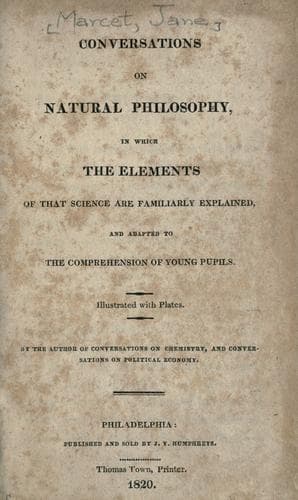
Conversations on Natural Philosophy, in which the Elements of that Science are Familiarly ExplainedMarcet, Mrs. (Jane Haldimand)
Science
Conversations on Natural Philosophy, in which the Elements of that Science are Familiarly Explained
Marcet, Mrs. (Jane Haldimand)
Physics
_Mrs. B:_ Fig. 5, plate 19, will make it clear to you: A A represents a
thick pane of glass, seen edgeways. When the ray B approaches the glass,
at C, it is refracted by it; and instead of continuing its course in the
same direction, as the dotted line describes, it passes through the
pane, to D; at that point returning into the air, it is again refracted
by the glass, but in a contrary direction to the first refraction, and
in consequence proceeds to E. Now you must observe that the ray B C and
the ray D E being parallel, the light does not appear to have suffered
any refraction: the apparent, differing so little from the true place of
any object, when seen through glass of ordinary thickness.
_Emily._ So that the effect which takes place on the ray entering the
glass, is undone on its quitting it. Or, to express myself more
scientifically, when a ray of light passes from one medium into another,
and through that into the first again, the two refractions being equal,
and in opposite directions, no sensible effect is produced.
_Caroline._ I think the effect is very sensible, for, in looking through
the glass of the window, I see objects very much distorted; articles
which I know to be straight, appear bent and broken, and sometimes the
parts seem to be separated to a distance from each other.
_Mrs. B._ That is because common window glass is not flat, its whole
surface being uneven. Rays from any object, falling upon it under
different angles, are, consequently, refracted in various ways, and thus
produce the distortion you have observed.
_Emily._ Is it not in consequence of refraction, that the glasses in
common spectacles, magnify objects seen through them?
_Mrs. B._ Yes. Glasses of this description are called _lenses_; of
these, there are several kinds, the names of which it will be necessary
for you to learn. Every lens is formed of glass, ground so as to form a
segment of a sphere, on one, or both sides. They are all represented at
fig. 1, plate 20. The most common, is the _double convex_ lens, D. This
is thick in the middle, and thin at the edges, like common spectacles,
or reading glasses. A B, is a _plano-convex_ lens, being flat on one
side, and convex on the other. E is a _double concave_, being, in all
respects, the reverse of D. C is a _plano-concave_, flat on one side,
and concave on the other. F is called a _meniscus_, or _concavo-convex_,
being concave on one, and convex on the other side. A line passing
through the centre of a lens, is called its _axis_.
_Caroline._ I should like to understand how the rays of light are
refracted, by means of a lens.
_Mrs. B._ When parallel rays (fig. 6) fall on a double convex _lens_,
that only, which falls in the direction of the axis of the lens, is
perpendicular to the surface; the other rays, falling obliquely, are
refracted towards the axis, and will meet at a point beyond the lens,
called its _focus_.
Public-domain text, read in full here on John Shaqi.
Reviews
Reviews
No reviews yet
Be the first to share your thoughts on this work.
Elsewhere in the archive
Join the Discussion
Join the discussion
Sign in to leave a comment or review.
Sign InorCreate an account