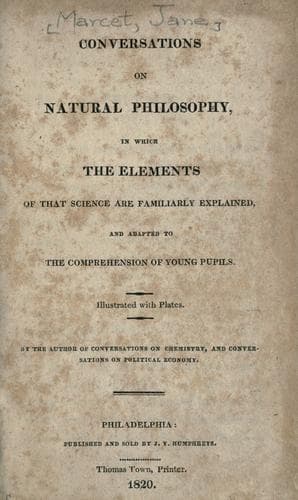
Conversations on Natural Philosophy, in which the Elements of that Science are Familiarly ExplainedMarcet, Mrs. (Jane Haldimand)
Science
Conversations on Natural Philosophy, in which the Elements of that Science are Familiarly Explained
Marcet, Mrs. (Jane Haldimand)
Physics
_Mrs. B._ The light of a candle, is not of so pure a white as that of
the sun: it has a yellowish tinge, and when refracted by the prism, the
yellow rays predominate; and blue bodies reflect some of the yellow
rays, from their being next to the blue, in the order of refrangibility;
the superabundance of yellow rays, which is supplied by the candle,
gives to blue bodies, a greenish hue.
_Caroline._ Candle-light must then give to all bodies, a yellowish
tinge, from the excess of yellow rays; and yet it is a common remark,
that people of a sallow complexion, appear fairer, or whiter, by
candle-light.
_Mrs. B._ The yellow cast of their complexion is not so striking, when
every surrounding object has a yellow tinge.
_Emily._ Pray, why does the sun appear red, through a fog?
[Illustration: PLATE XXI.]
_Mrs. B._ It is supposed to be owing to the rays, which are most
refrangible, being also the most easily reflected: in passing through an
atmosphere, loaded with moisture, as in foggy weather, and also in the
morning and evening, when mists prevail, the _violet_, _indigo_, _blue_,
and _green_ rays, are reflected back by the particles which load the
air; whilst the _yellow_, _orange_, and _red_ rays, being less
susceptible of reflection, pass on, and reach the eye.
_Caroline._ And, pray, why is the sky of a blue colour?
_Mrs. B._ You should rather say, the atmosphere; for the sky is a very
vague term, the meaning of which, it would be difficult to define,
philosophically.
_Caroline._ But the colour of the atmosphere should be white, since all
the rays traverse it, in their passage to the earth.
_Mrs. B._ Do not forget that the direct rays of light which pass from
the sun to the earth, do not meet our eyes, excepting when we are
looking at that luminary, and thus intercept them; in which case, you
know, that the sun appears white. The atmosphere is a transparent
medium, through which the sun's rays pass freely to the earth; but the
particles of which it is composed, also reflect the rays of light, and
it appears that they possess the property of reflecting the blue rays,
the most copiously: the light, therefore, which is reflected back into
the atmosphere, from the surface of the earth, falls upon these
particles of air, and the blue rays are returned by reflection: this
reflection is performed in every possible direction; so that whenever we
look at the atmosphere, some of these rays fall upon our eyes; hence we
see the air of a blue colour. If the atmosphere did not reflect any
rays, though the objects, on the surface of the earth, would be
illuminated, the sky would appear perfectly black.
_Caroline._ Oh, how melancholy would that be; and how pernicious to the
sight, to be constantly viewing bright objects against a black sky. But
what is the reason that bodies often change their colour; as leaves,
which wither in autumn, or a spot of ink, which produces an iron-mould
on linen?
Public-domain text, read in full here on John Shaqi.
Reviews
Reviews
No reviews yet
Be the first to share your thoughts on this work.
Elsewhere in the archive
Join the Discussion
Join the discussion
Sign in to leave a comment or review.
Sign InorCreate an account