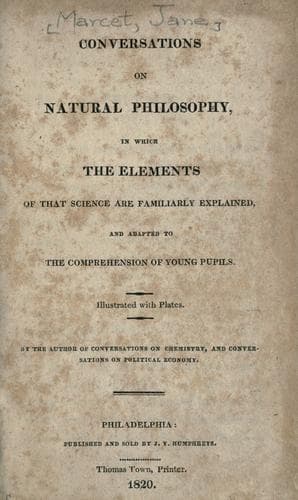
Conversations on Natural Philosophy, in which the Elements of that Science are Familiarly ExplainedMarcet, Mrs. (Jane Haldimand)
Science
Conversations on Natural Philosophy, in which the Elements of that Science are Familiarly Explained
Marcet, Mrs. (Jane Haldimand)
Physics
_Mrs. B._ The green leaves reflect both blue and yellow rays, which
produce a green colour. They are now in a coloured ray, which they have
a tendency to reflect; they, therefore, reflect more of the blue rays
than the rose, (which naturally absorbs that colour,) and will, of
course, appear of a brighter blue.
_Emily._ Yet, in passing the rose through the different colours of the
spectrum, the flower takes them more readily than the leaves.
_Mrs. B._ Because the flower is of a paler hue. Bodies which reflect all
the rays, are white; those which absorb them all, are black: between
these extremes, bodies appear lighter or darker, in proportion to the
quantity of rays they reflect or absorb. This rose is of a pale red; it
approaches nearer to white than to black, and therefore, reflects rays,
more abundantly than it absorbs them.
_Emily._ But if a rose has so strong a tendency to reflect rays, I
should imagine that it would be of a deep red colour.
_Mrs. B._ I mean to say, that it has a general tendency to reflect rays.
Pale coloured bodies, reflect all the coloured rays to a certain degree,
their paleness, being an approach towards whiteness: but they reflect
one colour more than the rest: this predominates over the white, and
determines the colour of the body. Since, then, bodies of a pale colour,
in some degree reflect all the rays of light, in passing through the
various colours of the spectrum, they will reflect them all, with
tolerable brilliancy; but will appear most vivid, in the ray of their
natural colour. The green leaves, on the contrary, are of a dark colour,
bearing a stronger resemblance to black, than to white; they have,
therefore, a greater tendency to absorb, than to reflect rays; and
reflecting very few of any, but the blue, and yellow rays, they will
appear dingy, in passing through the other colours of the spectrum.
_Caroline._ They must, however, reflect great quantities of the green
rays, to produce so deep a colour.
_Mrs. B._ Deepness or darkness of colour, proceeds rather from a
deficiency, than an abundance of reflected rays. Remember, that if
bodies reflected none of the rays, they would be black; and if a body
reflects only a few green rays, it will appear of a dark green; it is
the brightness, and intensity of the colour, which show that a great
quantity of rays are reflected.
_Emily._ A white body, then, which reflects all the rays, will appear
equally bright in all the colours of the spectrum.
_Mrs. B._ Certainly. And this is easily proved by passing a sheet of
white paper, through the rays of the spectrum.
White, you perceive, results from a body reflecting all the rays which
fall upon it; black, is produced, when they are all absorbed; and
colour, arises from a body possessing the power to decompose the solar
ray, by absorbing some parts, and reflecting others.
_Caroline._ What is the reason that articles which are blue, often
appear green, by candle-light?
Public-domain text, read in full here on John Shaqi.
Reviews
Reviews
No reviews yet
Be the first to share your thoughts on this work.
Elsewhere in the archive
Join the Discussion
Join the discussion
Sign in to leave a comment or review.
Sign InorCreate an account