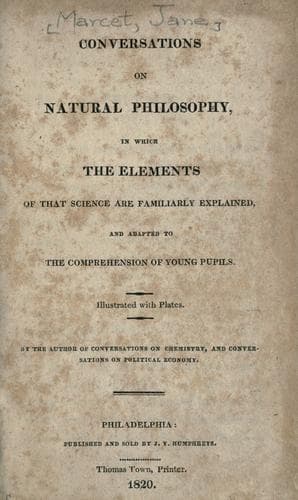
Conversations on Natural Philosophy, in which the Elements of that Science are Familiarly ExplainedMarcet, Mrs. (Jane Haldimand)
Science
Conversations on Natural Philosophy, in which the Elements of that Science are Familiarly Explained
Marcet, Mrs. (Jane Haldimand)
Physics
16. (Pg. 183) How are rays refracted, which fall obliquely upon a flat
pane of glass, (fig. 5, plate 19?)
17. (Pg. 183) What is the reason that objects are distorted, when seen
through common window glass?
18. (Pg. 184) What is meant by a lens?
19. (Pg. 184) What are the five kinds called, represented at fig. 1,
plate 20?
20. (Pg. 184) What is meant by the axis of a lens?
21. (Pg. 184) How are parallel rays, refracted by the double convex
lens, fig. 6, plate 19?
22. (Pg. 184) What is meant by the focus of a lens?
23. (Pg. 184) What is the focal distance of parallel rays, from a double
convex lens?
24. (Pg. 184) How are the rays refracted by a concave lens, fig. 7,
plate 19?
25. (Pg. 185) What is the effect of one plane side in a lens?
26. (Pg. 185) How is the focus of the plano-convex lens situated, fig.
2, plate 20?
27. (Pg. 185) How does a convex lens magnify objects, fig. 6, plate 19?
28. (Pg. 185) What is the article denominated which is represented at
fig. 3, plate 20?
29. (Pg. 185) How will a ray be refracted, which enters on one side of
the prism, in the direction A B?
30. (Pg. 185) What effect is produced by this refraction, as represented
in fig. 4, plate 20?
31. (Pg. 186) Of what are the rays of white light said to be composed?
32. (Pg. 186) What colours are produced?
33. (Pg. 186) By what property, in light, does refraction enable us to
separate these different rays?
34. (Pg. 187) What experiment may be performed with a piece of card, so
as to exemplify the compound nature of light?
35. (Pg. 187) How can the same be shown by a lens, fig. 5. plate 20?
36. (Pg. 187) Is it certain that there are seven primitive colours in
the spectrum?
37. (Pg. 188) How is the rainbow produced, and what is necessary to its
production?
38. (Pg. 188) How are the solar rays affected by a convex lens?
39. (Pg. 188) Why is such a lens, called a burning glass?
40. (Pg. 188) Why are bodies of a dark colour, more readily inflamed,
than those which are white?
41. (Pg. 189) What is believed to be the reason, why some bodies absorb
more rays than others?
42. (Pg. 189) What determines the colour of any particular body?
43. (Pg. 189) What exemplifications are given?
44. (Pg. 189) By what reasoning is it proved, that bodies do not retain
their colours in the dark?
45. (Pg. 190) What proof of the truth of this theory of colours, may be
afforded by the prism?
46. (Pg. 191) Why will green leaves, when exposed to the red ray, appear
of a dingy brown?
47. (Pg. 191) Bodies, in general, when placed in a ray differing in
colour from their own, appear of a mixed hue, what causes this?
48. (Pg. 191) Why will bodies of a pale, or light hue, most perfectly,
assume the different colours of the spectrum?
49. (Pg. 192) Upon what property in a body, does the darkness of its
colour depend?
50. (Pg. 192) Why do some bodies appear white, others black, and others
of different colours?
Public-domain text, read in full here on John Shaqi.
Reviews
Reviews
No reviews yet
Be the first to share your thoughts on this work.
Elsewhere in the archive
Join the Discussion
Join the discussion
Sign in to leave a comment or review.
Sign InorCreate an account