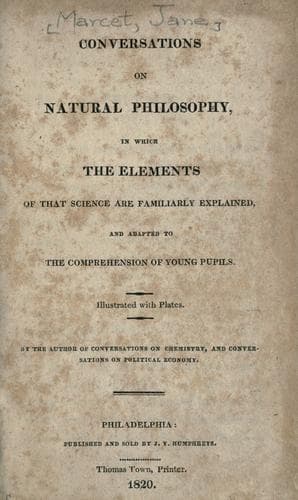
Conversations on Natural Philosophy, in which the Elements of that Science are Familiarly ExplainedMarcet, Mrs. (Jane Haldimand)
Science
Conversations on Natural Philosophy, in which the Elements of that Science are Familiarly Explained
Marcet, Mrs. (Jane Haldimand)
Physics
51. (Pg. 192) From what cause do blue articles appear green, by
candle-light?
52. (Pg. 193) What is believed to be the cause, of the red appearance of
the sun, through a fog, or misty atmosphere?
53. (Pg. 193) From what is the blue colour of the sky, thought to arise?
54. (Pg. 193) What would be the colour of the sky, did not the
atmosphere reflect light?
55. (Pg. 193) From what cause do some bodies change their colour, as
leaves formerly green, become brown, and ink, yellow?
56. (Pg. 194) Why is a black dress, warmer in the sunshine, than a white
one of the same texture?
CONVERSATION XVII.
ON THE STRUCTURE OF THE EYE, AND OPTICAL INSTRUMENTS.
DESCRIPTION OF THE EYE. OF THE IMAGE ON THE RETINA. REFRACTION BY THE
HUMOURS OF THE EYE. OF THE USE OF SPECTACLES. OF THE SINGLE MICROSCOPE.
OF THE DOUBLE MICROSCOPE. OF THE SOLAR MICROSCOPE. MAGIC LANTHORN.
REFRACTING TELESCOPE. REFLECTING TELESCOPE.
MRS. B.
The body of the eye, is of a spherical form: (fig. 1. plate 21.) it has
two membranous coats, or coverings; the external one, _a a a_, is called
the sclerotica, this is commonly known under the name of the white of
the eye; it has a projection in that part of the eye which is exposed to
view, _b b_, which is called the transparent cornea, because, when
dried, it has nearly the consistence of very fine horn, and is
sufficiently transparent for the light to obtain free passage through
it.
The second membrane which lines the cornea, and envelops the eye, is
called the choroid, _c c c_; this has an opening in front, just beneath
the cornea, which forms the pupil, or sight of the eye, _d d_, through
which the rays of light pass into the eye. The pupil is surrounded by a
coloured border called the iris, _e e_, which, by its muscular motion,
always preserves the pupil of a circular form, whether it is expanded in
the dark, or contracted by a strong light. This you will understand
better by examining fig. 2.
_Emily._ I did not know that the pupil was susceptible of varying its
dimensions.
_Mrs. B._ The construction of the eye is so admirable, that it is
capable of adapting itself, more or less, to the circumstances in which
it is placed. In a faint light, the pupil dilates so as to receive an
additional quantity of rays, and in a strong light, it contracts, in
order to prevent the intensity of the light from injuring the optic
nerve. Observe Emily's eyes, as she sits looking towards the windows:
the pupils appear very small, and the iris, large. Now, Emily, turn from
the light, and cover your eyes with your hand, so as entirely to exclude
it, for a few moments.
_Caroline._ How very much the pupils of her eyes are now enlarged, and
the iris diminished! This is, no doubt, the reason why the eyes suffer
pain, when from darkness, they suddenly come into a strong light; for
the pupil being dilated, a quantity of rays must rush in, before it has
time to contract.
Public-domain text, read in full here on John Shaqi.
Reviews
Reviews
No reviews yet
Be the first to share your thoughts on this work.
Elsewhere in the archive
Join the Discussion
Join the discussion
Sign in to leave a comment or review.
Sign InorCreate an account