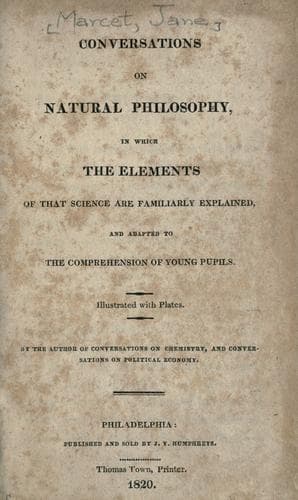
Conversations on Natural Philosophy, in which the Elements of that Science are Familiarly ExplainedMarcet, Mrs. (Jane Haldimand)
Science
Conversations on Natural Philosophy, in which the Elements of that Science are Familiarly Explained
Marcet, Mrs. (Jane Haldimand)
Physics
_Emily._ These divergent rays, issuing from a single point, I believe
you told us, were called a pencil of rays?
_Mrs. B._ Yes. Now, divergent rays, on entering the pupil, do not cross
each other; the pupil, however, is sufficiently large to admit a small
pencil of them; and these, if not refracted to a focus, by the humours,
would continue diverging after they had passed the pupil, would fall
dispersed upon the retina, and thus the image of a single point, would
be expanded over a large portion of the retina. The divergent rays from
every other point of the object, would be spread over a similar extent
of space, and would interfere and be confounded with the first; so that
no distinct image could be formed, and the representation on the retina
would be confused, both in figure and colour. Fig. 3. represents two
pencils of rays, issuing from two points of the tree, A B, and entering
the pupil C, refracted by the crystalline humour D, and forming on the
retina, at _a b_, distinct images of the spot they proceed from. Fig. 4.
differs from the preceding, merely from not being supplied with a lens;
in consequence of which, the pencils of rays are not refracted to a
focus, and no distinct image is formed on the retina. I have delineated
only the rays issuing from two points of an object, and distinguished
the two pencils in fig. 4. by describing one of them with dotted lines:
the interference of these two pencils of rays on the retina, will enable
you to form an idea of the confusion which would arise, from thousands
and millions of points, at the same instant pouring their divergent rays
upon the retina.
_Emily._ True; but I do not yet well understand, how the refracting
humours, remedy this imperfection.
_Mrs. B._ The refraction of these several humours, unites the whole of a
pencil of rays, proceeding from any one point of an object, to a
corresponding point on the retina, and the image is thus rendered
distinct and strong. If you conceive, in fig. 3., every point of the
tree to send forth a pencil of rays, similar to those from A B, every
part of the tree will be as accurately represented on the retina, as the
points _a b_.
_Emily._ How admirably, how wonderfully, is this contrived!
_Caroline._ But since the eye absolutely requires refracting humours, in
order to have a distinct representation formed on the retina, why is not
the same refraction equally necessary, for the images formed in the
camera obscura?
_Mrs. B._ It is; excepting the aperture through which we receive the
rays into the camera obscura, is extremely small; so that but very few
of the rays diverging from a point, gain admittance; but when we
enlarged the aperture, and furnished it with a lens, you found the
landscape more perfectly represented.
_Caroline._ I remember how obscure and confused the image was, when you
enlarged the opening, without putting in the lens.
Public-domain text, read in full here on John Shaqi.
Reviews
Reviews
No reviews yet
Be the first to share your thoughts on this work.
Elsewhere in the archive
Join the Discussion
Join the discussion
Sign in to leave a comment or review.
Sign InorCreate an account