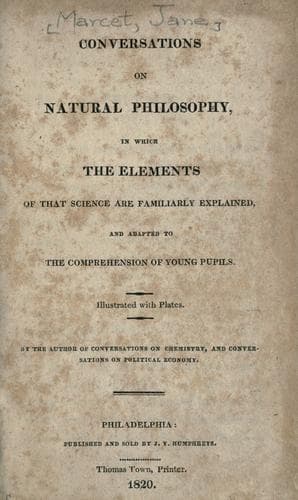
Conversations on Natural Philosophy, in which the Elements of that Science are Familiarly ExplainedMarcet, Mrs. (Jane Haldimand)
Science
Conversations on Natural Philosophy, in which the Elements of that Science are Familiarly Explained
Marcet, Mrs. (Jane Haldimand)
Physics
_Mrs. B._ Such, or very similar, would be the representation on the
retina, unassisted by the refracting humours.
You will now be able to understand the nature of that imperfection of
sight, which arises from the eyes being too prominent. In such cases,
the crystalline humour, D, (fig. 5.) being extremely convex, refracts
the rays too much, and collects a pencil, proceeding from the object A
B, into a focus, F, before they reach the retina. From this focus, the
rays proceed, diverging, and consequently form a very confused image on
the retina, at _a b_. This is the defect in short-sighted people.
_Emily._ I understand it perfectly. But why is this defect remedied by
bringing the object nearer to the eye, as we find to be the case with
short-sighted people?
_Mrs. B._ The nearer you bring an object to your eye, the more divergent
the rays fall upon the crystalline humour, and consequently they are not
so soon converged to a focus: this focus, therefore, either falls upon
the retina, or at least approaches nearer to it, and the object is
proportionally distinct, as in fig. 6.
_Emily._ The nearer, then, you bring an object to a lens, the further
the image recedes behind it.
_Mrs. B._ Certainly. But short-sighted persons have another resource,
for objects which they can not bring near to their eyes; this is, to
place a concave lens, C D, (fig. 1, plate 22.) before the eye, in order
to increase the divergence of the rays. The effect of a concave lens,
is, you know, exactly the reverse of a convex one: it renders parallel
rays divergent, and those which are already divergent, still more so. By
the assistance of such glasses, therefore, the rays from a distant
object, fall on the pupil, as divergent as those from a less distant
object; and, with short-sighted people, they throw the image of a
distant object, back, as far as the retina.
_Caroline._ This is an excellent contrivance, indeed.
_Mrs. B._ And tell me, what remedy would you devise for such persons as
have a contrary defect in their sight; that is to say, who are
long-sighted, in whom the crystalline humour, being too flat, does not
refract the rays sufficiently, so that they reach the retina before they
are converged to a point?
_Caroline._ I suppose that a contrary remedy must be applied to this
defect; that is to say, a convex lens, L M, fig. 2, to make up for the
deficiency of convexity of the crystalline humour, O P. For the convex
lens would bring the rays nearer together, so that they would fall,
either less divergent, or parallel, on the crystalline humour; and, by
being sooner converged to a focus, would fall on the retina.
_Mrs. B._ Very well, Caroline. This is the reason why elderly people,
the humours of whose eyes are decayed by age, are under the necessity of
using convex spectacles. And when deprived of that resource, they hold
the object at a distance from their eyes, as in fig. 3, in order to
bring the focus more forward.
Public-domain text, read in full here on John Shaqi.
Reviews
Reviews
No reviews yet
Be the first to share your thoughts on this work.
Elsewhere in the archive
Join the Discussion
Join the discussion
Sign in to leave a comment or review.
Sign InorCreate an account