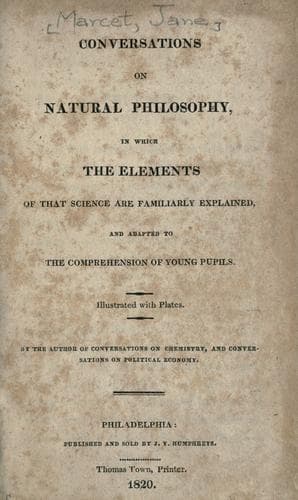
Conversations on Natural Philosophy, in which the Elements of that Science are Familiarly ExplainedMarcet, Mrs. (Jane Haldimand)
Science
Conversations on Natural Philosophy, in which the Elements of that Science are Familiarly Explained
Marcet, Mrs. (Jane Haldimand)
Physics
_Caroline._ I have often been surprised, when my grandfather reads
without his spectacles, to see him hold the book at a considerable
distance from his eyes. But I now understand the cause; the more distant
the object is from the crystalline lens, the nearer to it, will the
image be formed.
_Emily._ I comprehend the nature of these two opposite defects very
well; but I cannot now conceive, how any sight can be perfect: for, if
the crystalline humour is of a proper degree of convexity, to bring the
image of distant objects to a focus on the retina, it will not represent
near objects distinctly; and if, on the contrary, it is adapted to give
a clear image of near objects, it will produce a very imperfect one, of
distant objects.
_Mrs. B._ Your observation is very good, Emily; and it is true, that
every person would be subject to one of these two defects, if we had it
not in our power to adapt the eye, to the distance of the object; it is
believed that this is accomplished, by our having a command over the
crystalline lens, so as to project it towards, or draw it back from the
object, as circumstances require, by means of the two muscles, to which
the crystalline humour is attached; so that the focus of the rays,
constantly falls on the retina, and an image is formed equally distinct,
either of distant objects, or of those which are near.
_Caroline._ In the eyes of fishes, which are the only eyes I have ever
seen separate from the head, the cornea does not protrude, in that part
of the eye which is exposed to view.
_Mrs. B._ The cornea of the eye of a fish is not more convex than the
rest of the ball of the eye; but to supply this deficiency, their
crystalline humour is spherical, and refracts the rays so much, that it
does not require the assistance of the cornea to bring them to a focus
on the retina.
_Emily._ Pray, what is the reason that we cannot see an object
distinctly, if we place it very near to the eye?
_Mrs. B._ Because the rays fall on the crystalline humour, too divergent
to be refracted to a focus on the retina; the confusion, therefore,
arising from viewing an object too near the eye, is similar to that
which proceeds from a flattened crystalline humour; the rays reach the
retina before they are collected to a focus, (fig. 4.) If it were not
for this imperfection, we should be able to see and distinguish the
parts of objects, which, from their minuteness, are now invisible to us;
for, could we place them very near the eye, the image on the retina
would be so much magnified, as to render them visible.
_Emily._ And could there be no contrivance, to convey the rays of
objects viewed, close to the eye, so that they should be refracted to a
focus on the retina?
Public-domain text, read in full here on John Shaqi.
Reviews
Reviews
No reviews yet
Be the first to share your thoughts on this work.
Elsewhere in the archive
Join the Discussion
Join the discussion
Sign in to leave a comment or review.
Sign InorCreate an account