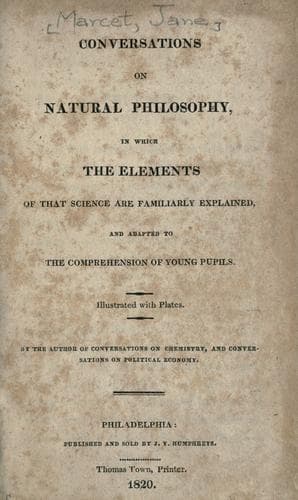
Conversations on Natural Philosophy, in which the Elements of that Science are Familiarly ExplainedMarcet, Mrs. (Jane Haldimand)
Science
Conversations on Natural Philosophy, in which the Elements of that Science are Familiarly Explained
Marcet, Mrs. (Jane Haldimand)
Physics
There is another kind of microscope, called the solar microscope, which
is the most wonderful from its great magnifying power: in this we also
view an image formed by a lens, not the object itself. As the sun
shines, I can show you the effect of this microscope; but for this
purpose, we must close the shutters, and admit only a small portion of
light, through the hole in the window-shutter, which we used for the
camera obscura. We shall now place the object A B, (plate 23, fig. 1.)
which is a small insect, before the lens C D, and nearly at its focus:
the image E F, will then be represented on the opposite wall, in the
same manner, as the landscape was in the camera obscura; with this
difference, that it will be magnified, instead of being diminished. I
shall leave you to account for this, by examining the figure.
_Emily._ I see it at once. The image E F is magnified, because it is
farther from the lens, than the object A B; while the representation of
the landscape was diminished, because it was nearer the lens, than the
landscape was. A lens, then, answers the purpose equally well, either
for magnifying or diminishing objects?
_Mrs. B._ Yes: if you wish to magnify the image, you place the object
near the focus of the lens; if you wish to produce a diminished image,
you place the object at a distance from the lens, in order that the
image may be formed in, or near the focus.
_Caroline._ The magnifying power of this microscope is prodigious: but
the indistinctness of the image, for want of light, is a great
imperfection. Would it not be clearer, if the opening in the shutter
were enlarged, so as to admit more light?
_Mrs. B._ If the whole of the light admitted, does not fall upon the
object, the effect will only be to make the room lighter, and the image
consequently less distinct.
_Emily._ But could you not by means of another lens, bring a large
pencil of rays to a focus on the object, and thus concentrate upon it
the whole of the light admitted?
_Mrs. B._ Very well. We shall enlarge the opening, and place the lens X
Y (fig. 2.) in it, to converge the rays to a focus on the object A B.
There is but one thing more wanting to complete the solar microscope,
which I shall leave to Caroline's sagacity to discover.
_Caroline._ Our microscope has a small mirror attached to it, upon a
moveable joint, which can be so adjusted as to receive the sun's rays,
and reflect them upon the object: if a similar mirror were placed to
reflect light upon the lens, would it not be a means of illuminating the
object more perfectly?
_Mrs. B._ You are quite right. P Q (fig. 2.) is a small mirror, placed
on the outside of the window-shutter, which receives the incident rays S
S, and reflects them on the lens X Y. Now that we have completed the
apparatus, let us examine the mites on this piece of cheese, which I
place near the focus of the lens.
Public-domain text, read in full here on John Shaqi.
Reviews
Reviews
No reviews yet
Be the first to share your thoughts on this work.
Elsewhere in the archive
Join the Discussion
Join the discussion
Sign in to leave a comment or review.
Sign InorCreate an account