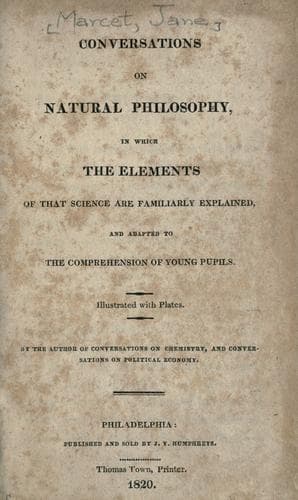
Conversations on Natural Philosophy, in which the Elements of that Science are Familiarly ExplainedMarcet, Mrs. (Jane Haldimand)
Science
Conversations on Natural Philosophy, in which the Elements of that Science are Familiarly Explained
Marcet, Mrs. (Jane Haldimand)
Physics
_Caroline._ Oh, how much more distinct the image now is, and how
wonderfully magnified! The mites on the cheese look like a drove of pigs
scrambling over rocks.
_Emily._ I never saw any thing so curious. Now, an immense piece of
cheese has fallen: one might imagine it an earthquake: some of the poor
mites must have been crushed; how fast they run--they absolutely seem to
gallop.
But this microscope can be used only for transparent objects; as the
light must pass through them, to form the image on the wall?
_Mrs. B._ Very minute objects, such as are viewed in a microscope, are
generally transparent, but when opaque objects are to be exhibited, a
mirror M N (fig. 3.) is used to reflect the light on the side of the
object next the wall: the image is then formed by light reflected from
the object, instead of being transmitted through it.
_Emily._ Pray, is not a magic lanthorn constructed on the same
principles?
_Mrs. B._ Yes, with this difference; the objects to be magnified, are
painted upon pieces of glass, and the light is supplied by a lamp,
instead of the sun.
The microscope is an excellent invention to enable us to see and
distinguish objects, which are too small to be visible to the naked eye.
But there are objects, which, though not really small, appear so to us,
from their distance; to these, we cannot apply the same remedy; for when
a house is so far distant, as to be seen under the same angle as a mite
which is close to us, the effect produced on the retina is the same: the
angle it subtends is not large enough for it to form a distinct image on
the retina.
_Emily._ Since it is impossible, in this case, to make the object
approach the eye, cannot we by means of a lens bring an image of it,
nearer to us?
_Mrs. B._ Yes; but then the object being very distant from the focus of
the lens, the image would be too small to be visible to the naked eye.
_Emily._ Then, why not look at the image through another lens, which
will act as a microscope, enable us to bring the image close to the eye,
and thus render it visible?
_Mrs. B._ Very well, Emily; I congratulate you on having invented a
telescope. In figure 4, the lens C D, forms an image E F, of the object
A B; and the lens X Y, serves the purpose of magnifying that image; and
this is all that is required in a common refracting telescope.
_Emily._ But in fig. 4, the image is not inverted on the retina, as
objects usually are: it should therefore appear to us inverted; and that
is not the case in the telescopes I have looked through.
_Mrs. B._ When it is necessary to represent the image erect, two other
lenses are required; by which means a second image is formed, the
reverse of the first, and consequently upright. These additional glasses
are used to view terrestrial objects; for no inconvenience arises from
seeing the celestial bodies inverted.
Public-domain text, read in full here on John Shaqi.
Reviews
Reviews
No reviews yet
Be the first to share your thoughts on this work.
Elsewhere in the archive
Join the Discussion
Join the discussion
Sign in to leave a comment or review.
Sign InorCreate an account