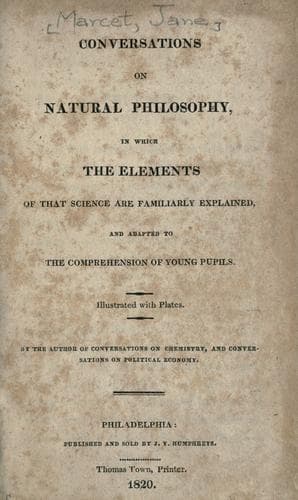
Conversations on Natural Philosophy, in which the Elements of that Science are Familiarly ExplainedMarcet, Mrs. (Jane Haldimand)
Science
Conversations on Natural Philosophy, in which the Elements of that Science are Familiarly Explained
Marcet, Mrs. (Jane Haldimand)
Physics
PHENOMENON. Any natural appearance is properly so called; the term,
however, is usually applied to extraordinary appearances, as eclipses,
transits, &c.
PISTON. That part of a pump, or other engine which is made to fit into a
hollow cylinder, or barrel; and to move up and down in it, in order to
raise water, or for any other purpose.
PLANE. A perfectly flat surface. The plane of the orbit of a planet, is
an imaginary flat surface, extending to every part of the orbit.
PLANET. Those bodies which revolve round the sun, in orbits nearly
circular. They are divided into _primary_, and _secondary_; these latter
are also called satellites, or moons; they revolve round the primary
planets, and accompany them in their courses round the sun.
PLUMB-LINE. A string, or cord, by which a weight is suspended; it is
used for the purpose of finding a line perpendicular to the horizon; the
weight being always attracted towards the centre of the earth.
PNEUMATICS. That branch of natural philosophy, which treats of the
mechanical properties of the atmosphere, or of air in general.
POLES. The extremities of the axis of motion either of our earth, or of
any other revolving sphere. The poles of the earth have never been
visited; the regions by which they are surrounded, being obstructed by
impassable barriers of ice.
POWER. That force which we apply to any mechanical instrument, to effect
a given purpose, is denominated power, from whatever source it may be
derived. We have the power of weights, of springs, of horses, of men, of
steam, &c.
PRISM. The instrument usually so called, is employed in optics to
decompose the solar ray: it consists of a piece of solid glass, several
inches in length, and having three flat sides; the ends are equal in
size, and are of course triangular.
PRECESSION OF THE EQUINOXES. Every equinox takes place a few seconds of
a degree, before the earth arrives at that part of the ecliptic in which
the preceding equinox occurred. This phenomenon is called the precession
of the equinoxes. There is consequently a gradual change of the places
of the signs of the zodiac: a fact, the discovery of which has thrown
much light on ancient chronology.
PROJECTION. That force by which motion is given to a body, by some power
acting upon it, independently of gravity.
PULLEY. One of the six mechanical powers. A wheel turning upon an axis,
with a line passing over it. It is the moveable pulley only, which gives
any mechanical advantage.
PUMP. An hydraulic, or pneumatic instrument, for the purpose of raising
water, or exhausting air.
QUADRANT. A quarter of a circle. An instrument used to measure the
elevation of a body in degrees above the horizon.
QUADRATURES OF THE MOON. That period in which she appears in the form of
a semicircle. She is then either in her first, or her last quarter; and
exactly half way, between the places of new, and of full moon.
Public-domain text, read in full here on John Shaqi.
Reviews
Reviews
No reviews yet
Be the first to share your thoughts on this work.
Elsewhere in the archive
Join the Discussion
Join the discussion
Sign in to leave a comment or review.
Sign InorCreate an account