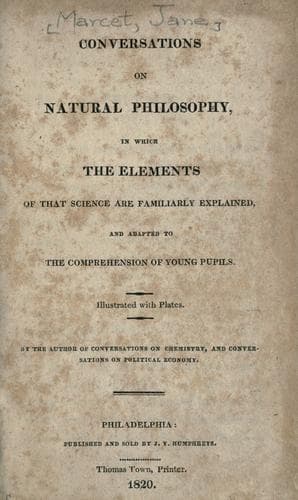
Conversations on Natural Philosophy, in which the Elements of that Science are Familiarly ExplainedMarcet, Mrs. (Jane Haldimand)
Science
Conversations on Natural Philosophy, in which the Elements of that Science are Familiarly Explained
Marcet, Mrs. (Jane Haldimand)
Physics
MOTION. A continued and successive change of place, either of a whole
body, or of the particles of which a body is composed; the earth in
revolving upon its axis only, would not change its place as a body, but
all the particles of which it is composed, would revolve round a common
axis of motion. In revolving in its orbit, its whole mass is constantly
occupying a new portion of space.
NATURAL PHILOSOPHY. That science which enquires into the laws which
govern all the natural bodies in the universe, in all their changes of
place, or of state.
NEAP TIDES. Those tides which occur when the moon is in her quadratures,
or half way between new, and full moon; at these periods the tides are
the lowest.
NODES. Those points in the orbit of the moon, or of a planet, where it
crosses the ecliptic or plane of the earth's orbit. When passing to the
north of the ecliptic, it is called the ascending node; when to the
south of it, the descending node.
OBLATE. See SPHEROID.
OCTAGON. A figure with eight sides, and consequently with eight angles.
OPAQUE. Not transparent; refusing a passage to the rays of light.
OPTICS. That branch of science which treats of light, and vision. It is
generally divided into two parts. _Catoptrics_, which treats of the
reflection of light, and _Dioptrics_, which treats of its refraction.
ORBIT. The line in which a primary planet moves in its revolution round
the sun; or a secondary planet, in its revolution round its primary.
These orbits are all elliptical, or oval.
PARABOLA. A particular kind of curve; that which a body describes in
rising and in falling, when thrown upwards, in any direction not
perpendicular to the horizon.
PARALLELOGRAM. A figure with four sides, having those which are
opposite, parallel to each other. A square, an oblong square, and the
figure usually called a diamond, are Parallelograms.
PARALLEL LINES. All lines, whether straight or curved, which are every
where at an equal distance from each other, are parallel lines.
PARALLEL OF LATITUDE. See LATITUDE.
PERIHELION. That part of the orbit of a planet, in which it approaches
the sun most nearly.
PENDULUM. A body suspended by a rod, or line, so that it may vibrate, or
oscillate, backwards and forwards. Pendulums of the same length, perform
their vibrations in the same time, whatever may be their weight, and
whether the arc of vibration, be long or short.
PERCUSSION. The striking of bodies against each other. The force of
this, depends upon the momentum of the striking body.
PERIOD. The time required for the revolution of one of the heavenly
bodies in its orbit.
PERPENDICULAR. Making an angle of 90 degrees with the horizon. When two
lines which meet, make an angle of 90 degrees, they are perpendicular to
each other.
PHASES. The various appearances of the disc, or face of the moon, and of
the planets; that portion of them which we see illuminated by the rays
of the sun.
Public-domain text, read in full here on John Shaqi.
Reviews
Reviews
No reviews yet
Be the first to share your thoughts on this work.
Elsewhere in the archive
Join the Discussion
Join the discussion
Sign in to leave a comment or review.
Sign InorCreate an account