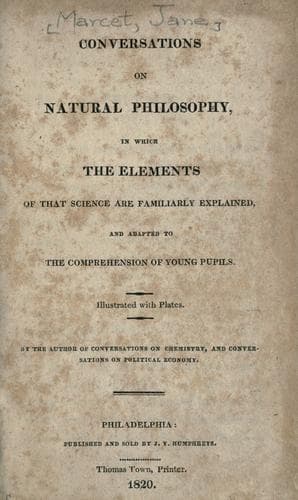
Conversations on Natural Philosophy, in which the Elements of that Science are Familiarly ExplainedMarcet, Mrs. (Jane Haldimand)
Science
Conversations on Natural Philosophy, in which the Elements of that Science are Familiarly Explained
Marcet, Mrs. (Jane Haldimand)
Physics
SIGNS, or CONSTELLATIONS. Collections, or groups, of stars. Those of the
zodiac are twelve, corresponding with the twelve months in the year. In
the centre of these the ecliptic is situated. The sun appears to pass in
succession through these signs; entering the first degree of Aries,
which is accounted the first sign, about the 21st of March.
SKY. That vast expanse, or space, in which the heavenly bodies are
situated. Its blue appearance is supposed to arise from the particles of
which the atmosphere is composed, possessing the property of reflecting
the blue rays, in greatest abundance.
SOLAR. Appertaining to, or governed by, the sun: as the solar system,
the solar year, solar eclipses.
SOLID. Not fluid. Having its parts connected so as to form a mass. Solid
bodies, are not absolutely so, all undoubtedly containing pores, or
spaces void of matter.
SOLSTICES. The middle of summer and the middle of winter; those two
points in the orbit of the earth, in which its poles point most directly
towards the sun.
SONOROUS BODIES. Those bodies which are capable of being put into a
state of vibration, so as to emit sounds.
SPECIFIC GRAVITY. The relative weight of bodies of different species,
when the same bulk of each is taken. Water has been chosen as the
standard for comparison. If we say that the specific gravity of a body
is 6, we mean, that its weight is six times as great as that of a
portion of water, exactly equal to it in bulk.
SPECTRUM. That appearance of differently coloured rays, which is
produced by the refraction of the solar ray, by means of a prism, is
called the prismatic spectrum; it exhibits most distinctly, and
beautifully, all the colours seen in the rainbow.
SPHERE. A globe, or ball.
SPHEROID. Spherical; a body approaching nearly to a sphere in its
figure. The earth, is denominated an _oblate spheroid_; it not being an
exact sphere, but flattened at the poles, so as to cause the polar
diameter to be upwards of thirty miles less than the equatorial. Oblate,
is the reverse of oblong, and means shorter in one direction, than in
another.
SPRING TIDES. Those tides which occur at the time of new, or of full
moon. The tides then rise to a greater height than at any other period.
SQUARE. A figure having four sides of equal length, and its angles all
right angles.
In numbers; the product of a number multiplied into itself; thus, the
square of 3 is 9, and the square of 8 is 64.
STAR. The _fixed_ stars are so called, because they retain their
relative situations; while the planets, by revolving in their orbits,
appear to wander amongst the fixed stars.
SUBTEND. This term is applied to the measurement of an angle; when the
lines by which it is bounded recede but little from each other, they are
said to subtend; that is, to be contained under, a small angle.
SUPERFICIES. The surface of any figure. Space extended in length and
width.
Public-domain text, read in full here on John Shaqi.
Reviews
Reviews
No reviews yet
Be the first to share your thoughts on this work.
Elsewhere in the archive
Join the Discussion
Join the discussion
Sign in to leave a comment or review.
Sign InorCreate an account