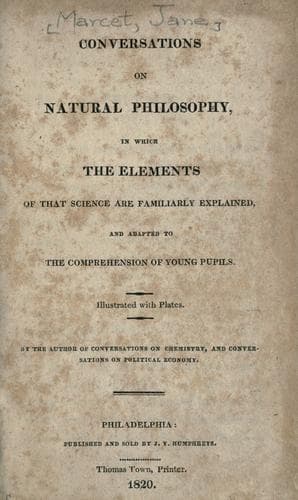
Conversations on Natural Philosophy, in which the Elements of that Science are Familiarly ExplainedMarcet, Mrs. (Jane Haldimand)
Science
Conversations on Natural Philosophy, in which the Elements of that Science are Familiarly Explained
Marcet, Mrs. (Jane Haldimand)
Physics
SYSTEM. The mutual connexion, and dependance of things, upon each other.
The solar, or Copernican system, includes the sun, the planets, with
their moons, and the comets.
TANGENT. A straight line touching the circumference of a circle; but
which would not cut off any portion of it, were it extended beyond the
touching point, in both directions.
TELESCOPE. An instrument by which distant objects may be distinctly
seen; the images of objects being brought near to the eye, and greatly
magnified.
TEMPERATE ZONES. Those portions of the surface of the earth situated
between 23-1/2 and 66-1/2 degrees of latitude. Within these boundaries,
the sun is never vertical; nor does he ever remain, during a whole day,
below the horizon.
THERMOMETER. An instrument for measuring the temperature of the
atmosphere, or of other bodies.
TORRID ZONE. That portion of the earth which extends 23-1/2 degrees on
each side of the equator, to the tropical circles; within this limit,
the sun is vertical, twice in the year.
TRANSIT. Mercury or Venus, are said to transit the sun, when they pass
between the earth and that luminary. They then appear like dark spots,
upon the face of the sun.
TRANSPARENT. Allowing the rays of light to pass freely through. The
reverse of opaque. Glass, water, air, &c. are transparent bodies.
TROPICS. Two circles on the globe on either hemisphere, at the distance
of 23-1/2 degrees from the equator. Beyond these circles, the sun is
never vertical: and the countries within them, are denominated tropical.
TWILIGHT. That portion of the morning or evening, in which the light of
the sun is perceptible, although he is below the horizon.
VACUUM. Space void of matter. Such is supposed to be the space in which
the planets revolve. We are said to produce a vacuum, when we exhaust
the air from a receiver.
VALVE. A part of a pump, and of some other instruments, which opens to
admit the passage of a fluid in one direction, but closes when pressed
in the opposite direction, so as to prevent the return of the fluid; a
pair of bellows is furnished with a valve.
VAPOUR. Exhalations from fluid or solid substances, generally mixing
with the atmosphere. The most abundant, is that from water.
VERTICAL. Exactly over our heads: ninety degrees above our horizon.
VIBRATION. The alternate motion of a body, forwards and backwards;
swinging, as a pendulum.
VISUAL. Belonging to vision; as the visual angle, or that angle formed
by the rays of light which enter the eye, from the extremities of any
object.
UNDULATION. A vibratory, or wave-like motion communicated to fluids.
Sound, is said to be propagated by the undulatory, or vibratory motion
of the air.
WEDGE. One of the mechanical powers; the form of the wedge is well
known. It is of extensive use; serving to rend bodies of great strength,
and to raise enormous weights.
Public-domain text, read in full here on John Shaqi.
Reviews
Reviews
No reviews yet
Be the first to share your thoughts on this work.
Elsewhere in the archive
Join the Discussion
Join the discussion
Sign in to leave a comment or review.
Sign InorCreate an account