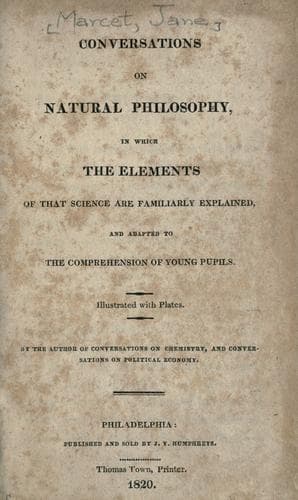
Conversations on Natural Philosophy, in which the Elements of that Science are Familiarly ExplainedMarcet, Mrs. (Jane Haldimand)
Science
Conversations on Natural Philosophy, in which the Elements of that Science are Familiarly Explained
Marcet, Mrs. (Jane Haldimand)
Physics
_Caroline._ If for instance the resistance of a carriage was greater
than the strength of the horses employed to draw it, they would not be
able to make it move.
_Mrs. B._ 3dly. We are to consider the support or prop, or as it is
termed in mechanics, the _fulcrum_; this you may recollect is the point
upon which the body turns when in motion; and lastly, the respective
velocities of the power, and of the resistance.
_Emily._ That must in general depend upon their respective distances
from the fulcrum, or from the axis of motion; as we observed in the
motion of the vanes of the windmill.
_Mrs. B._ We shall now examine the power of the lever. The _lever is an
inflexible rod or bar, moveable about a fulcrum, and having forces
applied to two or more points on it_. For instance, the steel rod to
which these scales are suspended is a lever, and the point in which it
is supported, the fulcrum, or centre of motion; now, can you tell me why
the two scales are in equilibrium?
_Caroline._ Being both empty, and of the same weight, they balance each
other.
_Emily._ Or, more correctly speaking, because the centre of gravity
common to both, is supported.
_Mrs. B._ Very well; and where is the centre of gravity of this pair of
scales? (fig. 1. plate 4.)
_Emily._ You have told us that when two bodies of equal weight were
fastened together, the centre of gravity was in the middle of the line
that connected them; the centre of gravity of the scales must therefore
be supported by the fulcrum F of the lever which unites the two scales,
and which is the centre of motion.
_Caroline._ But if the scales contained different weights, the centre of
gravity would no longer be in the fulcrum of the lever, but remove
towards that scale which contained the heaviest weight; and since that
point would no longer be supported, the heavy scale would descend, and
out-weigh the other.
_Mrs. B._ True; but tell me, can you imagine any mode by which bodies of
different weights can be made to balance each other, either in a pair of
scales, or simply suspended to the extremities of the lever? for the
scales are not an essential part of the machine; they have no mechanical
power, and are used merely for the convenience of containing the
substance to be weighed.
_Caroline._ What! make a light body balance a heavy one? I cannot
conceive that possible.
_Mrs. B._ The fulcrum of this pair of scales (fig. 2.) is moveable, you
see; I can take it off the beam, and fasten it on again in another part;
this part is now become the fulcrum, but it is no longer in the centre
of the lever.
_Caroline._ And the scales are no longer true; for that which hangs on
the longest side of the lever descends.
_Mrs. B._ The two parts of the lever divided by the fulcrum, are called
its arms; you should therefore say the longest arm, not the longest side
of the lever.
Public-domain text, read in full here on John Shaqi.
Reviews
Reviews
No reviews yet
Be the first to share your thoughts on this work.
Elsewhere in the archive
Join the Discussion
Join the discussion
Sign in to leave a comment or review.
Sign InorCreate an account