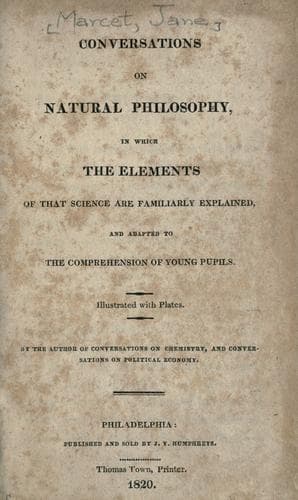
Conversations on Natural Philosophy, in which the Elements of that Science are Familiarly ExplainedMarcet, Mrs. (Jane Haldimand)
Science
Conversations on Natural Philosophy, in which the Elements of that Science are Familiarly Explained
Marcet, Mrs. (Jane Haldimand)
Physics
7. (Pg. 55) When and why do the scales balance each other, and where is
their centre of gravity? (fig. 1. plate 4.)
8. (Pg. 55) Why would they not balance with unequal weights?
9. (Pg. 55) Were the fulcrum removed from the middle of the beam what
would result?
10. (Pg. 55) What do we mean by the arms of a lever?
11. (Pg. 56) How may a pair of scales be false, and yet appear to be
true?
12. (Pg. 56) If the fulcrum be removed from the centre of gravity, how
may the equilibrium be restored?
13. (Pg. 56) How is this exemplified by fig. 3. plate 4?
14. (Pg. 56) What proportion must the weights bear to the lengths of the
arms?
15. (Pg. 57) On what principle do we weigh with a pair of steelyards,
and what will be the difference in the motion of the extremities of such
a lever?
16. (Pg. 58) How is this exemplified by fig. 4. plate 4?
17. (Pg. 58) What line is described by the ends of a lever? fig. 4.
plate 4.
18. (Pg. 58) How many kinds are there; and in the first how is the
fulcrum situated?
19. (Pg. 58) When may the fulcrum be so situated that this lever is not
a mechanical power, and why?
20. (Pg. 59) What is represented by fig. 5. plate 4?
21. (Pg. 59) Give a familiar example of the use of a lever of the first
kind.
22. (Pg. 59) In what instruments are two such levers combined?
23. (Pg. 59) How may two horses of unequal strength, be advantageously
coupled in a carriage?
24. (Pg. 60) Describe a lever of the second kind. (Fig. 6. plate 4.)
25. (Pg. 60) What is represented in fig. 7. plate 4, and in what
proportion does this lever gain power?
26. (Pg. 60) What is said respecting a door?
27. (Pg. 60) Describe a lever of the third kind.
28. (Pg. 60) In what instance do we use this?
29. (Pg. 61) What remarks are made on its employment in the limbs of
animals?
30. (Pg. 61) What are the conditions of equilibrium in every lever?
CONVERSATION V.
CONTINUED.
ON THE MECHANICAL POWERS.
OF THE PULLEY. OF THE WHEEL AND AXLE. OF THE INCLINED PLANE. OF THE
WEDGE. OF THE SCREW.
MRS. B.
The pulley is the second mechanical power we are to examine. You both, I
suppose, have seen a pulley?
_Caroline._ Yes, frequently: it is a circular, and flat piece of wood or
metal, with a string which runs in a groove round it: by means of which,
a weight may be pulled up; thus pulleys are used for drawing up
curtains.
_Mrs. B._ Yes; but in that instance the pulleys are fixed; that is, they
retain their places, and merely turn round on their axis; these do not
increase the power to raise the weights, as you will perceive by this
figure. (plate 5. fig. 1.) Observe that the fixed pulley is on the same
principle as the lever of a pair of scales, in which the fulcrum F being
in the centre of gravity, the power P and the weight W, are equally
distant from it, and no advantage is gained.
Public-domain text, read in full here on John Shaqi.
Reviews
Reviews
No reviews yet
Be the first to share your thoughts on this work.
Elsewhere in the archive
Join the Discussion
Join the discussion
Sign in to leave a comment or review.
Sign InorCreate an account