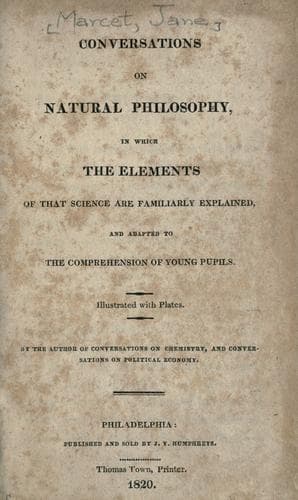
Conversations on Natural Philosophy, in which the Elements of that Science are Familiarly ExplainedMarcet, Mrs. (Jane Haldimand)
Science
Conversations on Natural Philosophy, in which the Elements of that Science are Familiarly Explained
Marcet, Mrs. (Jane Haldimand)
Physics
_Mrs. B._ They are, I believe, generally connected as described in
figure 4, both for nautical, and a variety of other purposes; but in
whatever manner pulleys are connected by a single string, the mechanical
power is the same.
The third mechanical power, is the wheel and axle. Let us suppose (plate
6. fig. 5) the weight W, to be a bucket of water in a well, which we
raise by winding round the axle the rope, to which it is attached; if
this be done without a wheel to turn the axle, no mechanical assistance
is received. The axle without a wheel is as impotent as a single fixed
pulley, or a lever, whose fulcrum is in the centre: but add the wheel to
the axle, and you will immediately find the bucket is raised with much
less difficulty. The velocity of the circumference of the wheel is as
much greater than that of the axle, as it is further from the centre of
motion; for the wheel describes a great circle in the same space of time
that the axle describes a small one, therefore the power is increased in
the same proportion as the circumference of the wheel is greater than
that of the axle. If the velocity of the wheel is twelve times greater
than that of the axle, a power twelve times less than the weight of the
bucket, would balance it; and a small increase would raise it.
_Emily._ The axle acts the part of the shorter arm of the lever, the
wheel that of the longer arm.
_Caroline._ In raising water, there is commonly, I believe, instead of a
wheel attached to the axle, only a crooked handle, which answers the
purpose of winding the rope round the axle, and thus raising the bucket.
_Mrs. B._ In this manner (fig. 6;) now if you observe the dotted circle
which the handle describes in winding up the rope, you will perceive
that the branch of the handle A, which is united to the axle, represents
the spoke of a wheel, and answers the purpose of an entire wheel; the
other branch B affords no mechanical aid, merely serving as a handle to
turn the wheel.
Wheels are a very essential part of most machines; they are employed in
various ways; but, when fixed to the axle, their mechanical power is
always the same: that is, as the circumference of the wheel exceeds that
of the axle, so much will the energy of the power be increased.
_Caroline._ Then the larger the wheel, in proportion to the axle, the
greater must be its effect?
_Mrs. B._ Certainly. If you have ever seen any considerable mills or
manufactures, you must have admired the immense wheel, the revolution of
which puts the whole of the machinery into motion; and though so great
an effect is produced by it, a horse or two has sufficient power to turn
it; sometimes a stream of water is used for that purpose, but of late
years, a steam-engine has been found both the most powerful and the most
convenient mode of turning the wheel.
_Caroline._ Do not the vanes of a windmill represent a wheel, Mrs. B.?
Public-domain text, read in full here on John Shaqi.
Reviews
Reviews
No reviews yet
Be the first to share your thoughts on this work.
Elsewhere in the archive
Join the Discussion
Join the discussion
Sign in to leave a comment or review.
Sign InorCreate an account