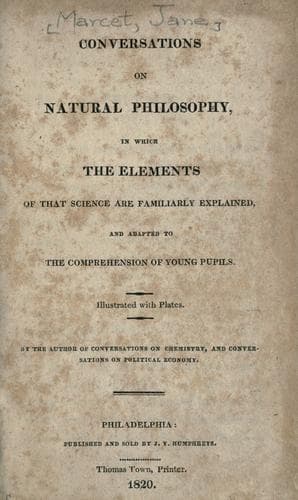
Conversations on Natural Philosophy, in which the Elements of that Science are Familiarly ExplainedMarcet, Mrs. (Jane Haldimand)
Science
Conversations on Natural Philosophy, in which the Elements of that Science are Familiarly Explained
Marcet, Mrs. (Jane Haldimand)
Physics
_Mrs. B._ Yes; and in this instance we have the advantage of a
gratuitous force, the wind, to turn the wheel. One of the great benefits
resulting from the use of machinery is, that it gives us a sort of
empire over the powers of nature, and enables us to make them perform
the labour which would otherwise fall to the lot of man. When a current
of wind, a stream of water, or the expansive force of steam, performs
our task, we have only to superintend and regulate their operations.
The fourth mechanical power is the inclined plane; this is generally
nothing more than a plank placed in a sloping direction, which is
frequently used to facilitate the raising of weights, to a small height,
such as the rolling of hogsheads or barrels into a warehouse. It is not
difficult to understand, that a weight may much more easily be rolled up
a slope than it can be raised the same height perpendicularly. But in
this, as well as the other mechanical powers, the facility is purchased
by a loss of time (fig. 7;) for the weight, instead of moving directly
from A to C, must move from B to C, and as the length of the plane is to
its height, so much is the resistance of the weight diminished.
_Emily._ Yes; for the resistance, instead of being confined to the short
line A C, is spread over the long line B C.
_Mrs. B._ The wedge, which is the next mechanical power, is usually
viewed as composed of two inclined planes (fig. 8:) you may have seen
wood-cutters use it to cleave wood. The resistance consists in the
cohesive attraction of the wood, or any other body which the wedge is
employed to separate; the advantage gained by this power is differently
estimated by philosophers; but one thing is certain, its power is
increased, in proportion to the decrease of its thickness, compared with
its length. The wedge is a very powerful instrument, but it is always
driven forward by blows from a hammer, or some other body having
considerable momentum.
_Emily._ The wedge, then, is rather a compound than a distinct
mechanical power, since it is not propelled by simple pressure, or
weight, like the other powers.
_Mrs. B._ It is so. All cutting instruments are constructed upon the
principle of the inclined plane, or the wedge: those that have but one
edge sloped, like the chisel, may be referred to the inclined plane;
whilst the axe, the hatchet, and the knife, (when used to split asunder)
are used as wedges.
_Caroline._ But a knife cuts best when it is drawn across the substance
it is to divide. We use it thus in cutting meat, we do not chop it to
pieces.
_Mrs. B._ The reason of this is, that the edge of a knife is really a
very fine saw, and therefore acts best when used like that instrument.
Public-domain text, read in full here on John Shaqi.
Reviews
Reviews
No reviews yet
Be the first to share your thoughts on this work.
Elsewhere in the archive
Join the Discussion
Join the discussion
Sign in to leave a comment or review.
Sign InorCreate an account