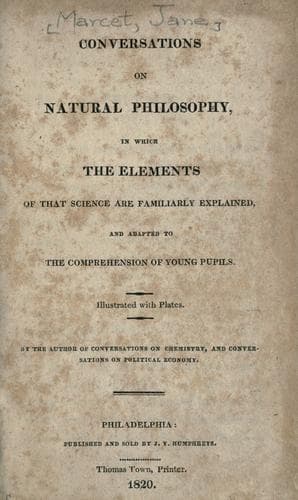
Conversations on Natural Philosophy, in which the Elements of that Science are Familiarly ExplainedMarcet, Mrs. (Jane Haldimand)
Science
Conversations on Natural Philosophy, in which the Elements of that Science are Familiarly Explained
Marcet, Mrs. (Jane Haldimand)
Physics
_Emily._ However plausible your objection appears, Caroline, I think you
place too much reliance upon it: when any one has given such convincing
proofs of sagacity and wisdom as Sir Isaac Newton, when we find that his
opinions are universally received and adopted, is it to be expected that
any objection we can advance should overturn them?
_Caroline._ Yet I confess that I am not inclined to yield implicit faith
even to opinions of the great Newton: for what purpose are we endowed
with reason, if we are denied the privilege of making use of it, by
judging for ourselves.
_Mrs. B._ It is reason itself which teaches us, that when we, novices in
science, start objections to theories established by men of knowledge
and wisdom, we should be diffident rather of our own than of their
opinion. I am far from wishing to lay the least restraint on your
questions; you cannot be better convinced of the truth of a system, than
by finding that it resists all your attacks, but I would advise you not
to advance your objections with so much confidence, in order that the
discovery of their fallacy may be attended with less mortification. In
answer to that you have just proposed, I can only say, that the earth
really is attracted by the sun.
_Caroline._ Take care, at least, that we are not consumed by him, Mrs.
B.
_Mrs. B._ We are in no danger; but Newton, our magician, as you are
pleased to call him, cannot extricate himself from this difficulty
without the aid of some cabalistical figures, which I must draw for him.
Let us suppose the earth, at its creation, to have been projected
forwards into universal space: we know that if no obstacle impeded its
course it would proceed in the same direction, and with a uniform
velocity for ever. In fig. 1. plate 6, A represents the earth, and S the
sun. We shall suppose the earth to be arrived at the point in which it
is represented in the figure, having a velocity which would carry it on
to B in the space of one month; whilst the sun's attraction would bring
it to C in the same space of time. Observe that the two forces of
projection and attraction do not act in opposition, but perpendicularly,
or at a right angle to each other. Can you tell me now, how the earth
will move?
_Emily._ I recollect your teaching us that a body acted upon by two
forces perpendicular to each other, would move in the diagonal of a
parallelogram; if, therefore, I complete the parallelogram, by drawing
the lines C D, B D, the earth will move in the diagonal A D.
_Mrs. B._ A ball struck by two forces acting perpendicularly to each
other, it is true, moves in the diagonal of a parallelogram; but you
must observe that the force of attraction is continually acting upon our
terrestrial ball, and producing an incessant deviation from its course
in a right line, which converts it into that of a curve-line; every
point of which may be considered as constituting the diagonal of an
infinitely small parallelogram.
Public-domain text, read in full here on John Shaqi.
Reviews
Reviews
No reviews yet
Be the first to share your thoughts on this work.
Elsewhere in the archive
Join the Discussion
Join the discussion
Sign in to leave a comment or review.
Sign InorCreate an account