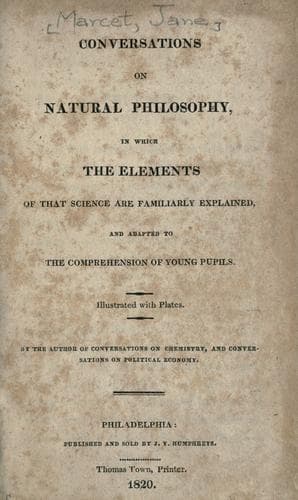
Conversations on Natural Philosophy, in which the Elements of that Science are Familiarly ExplainedMarcet, Mrs. (Jane Haldimand)
Science
Conversations on Natural Philosophy, in which the Elements of that Science are Familiarly Explained
Marcet, Mrs. (Jane Haldimand)
Physics
38. (Pg. 64) What name is given to two or more pulleys connected by one
string?
39. (Pg. 64) How do we estimate the power gained by a system of pulleys?
40. (Pg. 65) What is represented by fig. 5. plate 5?
41. (Pg. 65) How does the wheel operate in increasing power?
42. (Pg. 65) How is this compared with the lever?
43. (Pg. 65) How does a handle fixed to an axle, represent a wheel, fig.
6?
44. (Pg. 65) How could we increase the power in this instrument?
45. (Pg. 66) What other forces besides the power of men, do we employ to
move machines?
46. (Pg. 66) What will serve as an example of an inclined plane?
47. (Pg. 66) In what proportion does it gain power? (fig. 7.)
48. (Pg. 66) To what is the wedge compared? (fig. 8.)
49. (Pg. 66) How does its power increase?
50. (Pg. 67) Why is it rather a compound than a simple power?
51. (Pg. 67) What common instruments act upon the principle of the
inclined plane, or the wedge?
52. (Pg. 67) Why does a knife cut best when drawn across?
53. (Pg. 67) The screw has two essential parts; what are they?
54. (Pg. 67) What other instrument is used to turn the screw?
55. (Pg. 67) How can you compare the screw with an inclined plane? Fig.
10.
56. (Pg. 68) By what two means may the power of the screw be increased?
57. (Pg. 68) How do we estimate the power gained by the screw?
58. (Pg. 68) Is the lever always attached to the nut, as in the figure?
59. (Pg. 68) What is said respecting the composition of all machines,
and for what must allowance always be made in estimating their power?
60. (Pg. 69) What is meant by friction, and what causes it?
61. (Pg. 69) How may friction be diminished?
62. (Pg. 69) Friction is of two kinds, what are they?
63. (Pg. 69) For what purpose are wheels often used?
64. (Pg. 69) When is the friction of a carriage wheel changed from the
rolling to the rubbing friction?
65. (Pg. 70) What is a medium, and in what proportion does it diminish
motion?
66. (Pg. 70) Under what circumstances must a body be placed, in order to
move without impediment?
CONVERSATION VI.
CAUSES OF THE MOTION OF THE HEAVENLY BODIES.
OF THE EARTH'S ANNUAL MOTION. OF THE PLANETS AND THEIR MOTION. OF THE
DIURNAL MOTION OF THE EARTH AND PLANETS.
CAROLINE.
I am come to you to-day quite elated with the spirit of opposition, Mrs.
B.; for I have discovered such a powerful objection to your theory of
attraction, that I doubt whether even your conjuror Newton, with his
magic wand of gravitation, will be able to dispel it.
_Mrs. B._ Well, my dear, pray what is this weighty objection?
[Illustration: PLATE VI.]
_Caroline._ You say that the earth revolves in its orbit round the sun
once in a year, and that bodies attract in proportion to the quantity of
matter they contain; now we all know the sun to be much larger than the
earth: why, therefore does it not draw the earth into itself; you will
not, I suppose, pretend to say that we are falling towards the sun?
Public-domain text, read in full here on John Shaqi.
Reviews
Reviews
No reviews yet
Be the first to share your thoughts on this work.
Elsewhere in the archive
Join the Discussion
Join the discussion
Sign in to leave a comment or review.
Sign InorCreate an account