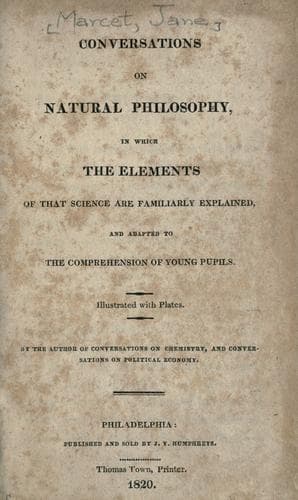
Conversations on Natural Philosophy, in which the Elements of that Science are Familiarly ExplainedMarcet, Mrs. (Jane Haldimand)
Science
Conversations on Natural Philosophy, in which the Elements of that Science are Familiarly Explained
Marcet, Mrs. (Jane Haldimand)
Physics
6. (Pg. 81) What is meant by the square of a number, and what examples
can you give?
7. (Pg. 81) What then would be the effect of removing it to three, or
four times its former distance?
8. (Pg. 81) How is the rule upon this subject expressed?
9. (Pg. 81) Does this apply to any power excepting gravitation?
10. (Pg. 81) How is it that a secondary planet revolves round its
primary, and is not drawn off by the sun?
11. (Pg. 82) What is said respecting the revolution of the moon, and of
the earth, round a common centre of gravity?
12. (Pg. 82) By what law in mechanics is this explained?
13. (Pg. 82) What motions then has the earth, and are these remarks
confined to it alone?
14. (Pg. 82) What effect have the planets upon the sun, and what is said
of the common centre of gravity of the system?
15. (Pg. 83) What other motion has the sun, and how is it proved?
16. (Pg. 83) How may you observe the motion of a planet, by means of a
fixed star?
17. (Pg. 83) What is represented by fig. 1. plate 7?
18. (Pg. 83) Why are the orbits represented as circular?
19. (Pg. 83) In what order do the planets increase in size as
represented, fig. 2. plate 7?
20. (Pg. 83) What are we told respecting Mercury?
21. (Pg. 84) What respecting Venus?
22. (Pg. 84) When does Venus become a morning, and when an evening star?
23. (Pg. 84) What is said of the Earth?
24. (Pg. 84) What of Mars?
25. (Pg. 84) What four small planets follow next?
26. (Pg. 85) What is said of Jupiter?
27. (Pg. 85) What of Saturn?
28. (Pg. 85) What of Herschel?
29. (Pg. 85) Why do we conclude that the moons of Saturn afford less
light than ours?
30. (Pg. 85) In what proportion will the light and heat at Saturn be
diminished, and why?
31. (Pg. 86) What do the comets resemble, and what is remarkable in
their orbits?
32. (Pg. 86) What is said of the number of comets?
33. (Pg. 86) What is a constellation?
34. (Pg. 86) How are the twelve constellations, or signs, called the
zodiac, situated?
35. (Pg. 86) Name them.
36. (Pg. 86) What is meant by the sun being in a sign?
37. (Pg. 86) What causes the apparent change of the sun's place?
38. (Pg. 87) The stars appear of different magnitudes, by what may this
be caused?
39. (Pg. 87) We are not sensible of the motion of the earth; what fact
is mentioned to illustrate this point?
40. (Pg. 87) What does this teach us?
41. (Pg. 88) Would the slowness, or the rapidity of the motion, if
steady, produce any sensible difference?
42. (Pg. 88) If we do not feel the motion of the earth, how may we be
convinced of its reality?
43. (Pg. 89) Were we to deny the motion of the earth upon its axis, what
must we admit respecting the heavenly bodies?
44. (Pg. 89) What distance is an inhabitant on the equator carried in a
minute by the diurnal motion of the earth?
45. (Pg. 89) Why is not the velocity every where equally great?
46. (Pg. 89) What distance does the earth travel in a minute, in its
revolution round the sun?
Public-domain text, read in full here on John Shaqi.
Reviews
Reviews
No reviews yet
Be the first to share your thoughts on this work.
Elsewhere in the archive
Join the Discussion
Join the discussion
Sign in to leave a comment or review.
Sign InorCreate an account