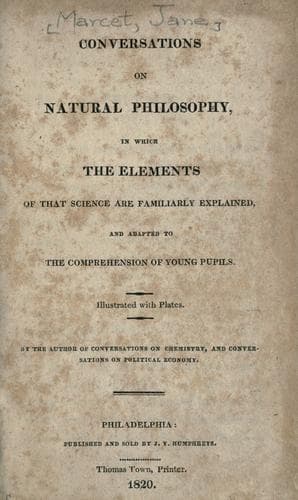
Conversations on Natural Philosophy, in which the Elements of that Science are Familiarly ExplainedMarcet, Mrs. (Jane Haldimand)
Science
Conversations on Natural Philosophy, in which the Elements of that Science are Familiarly Explained
Marcet, Mrs. (Jane Haldimand)
Physics
_Mrs. B._ This was the system of Ptolemy, in ancient times; but as long
ago as the beginning of the sixteenth century it was generally
discarded, and the solar system, such as I have shown you, was
established by the celebrated astronomer Copernicus, and is hence called
the Copernican system. But the theory of gravitation, the source from
which this beautiful and harmonious arrangement flows, we owe to the
powerful genius of Newton, who lived at a much later period, and who
demonstrated its truth.
_Emily._ It appears, indeed, far less difficult to trace by observation
the motion of the planets, than to divine by what power they are
impelled and guided. I wonder how the idea of gravitation could first
have occurred to sir Isaac Newton?
_Mrs. B._ It is said to have been occasioned by a circumstance from
which one should little have expected so grand a theory to have arisen.
During the prevalence of the plague in the year 1665, Newton retired
into the country to avoid the contagion: when sitting one day in an
orchard, he observed an apple fall from a tree, and was led to consider
what could be the cause which brought it to the ground.
_Caroline._ If I dared to confess it, Mrs. B., I should say that such an
inquiry indicated rather a deficiency than a superiority of intellect. I
do not understand how any one can wonder at what is so natural and so
common.
_Mrs. B._ It is the mark of superior genius to find matter for wonder,
observation, and research, in circumstances which, to the ordinary mind,
appear trivial, because they are common; and with which they are
satisfied, because they are natural; without reflecting that nature is
our grand field of observation, that within it, is contained our whole
store of knowledge; in a word, that to study the works of nature, is to
learn to appreciate and admire the wisdom of God. Thus, it was the
simple circumstance of the fall of an apple, which led to the discovery
of the laws upon which the Copernican system is founded; and whatever
credit this system had obtained before, it now rests upon a basis from
which it cannot be shaken.
_Emily._ This was a most fortunate apple, and more worthy to be
commemorated than all those that have been sung by the poets. The apple
of discord for which the goddesses contended; the golden apples by which
Atalanta won the race; nay, even the apple which William Tell shot from
the head of his son, cannot be compared to this!
Questions
1. (Pg. 80) Into what two classes are the planets divided, and how are
they distinguished?
2. (Pg. 80) By what reasoning do you prove that the sun contains a
greater quantity of matter than any other body in the system?
3. (Pg. 81) What two circumstances govern the force with which bodies
attract each other?
4. (Pg. 81) Were a planet removed to double its former distance from the
sun, what would be the effect upon its attractive force?
5. (Pg. 81) Why would it be reduced to one-fourth?
Public-domain text, read in full here on John Shaqi.
Reviews
Reviews
No reviews yet
Be the first to share your thoughts on this work.
Elsewhere in the archive
Join the Discussion
Join the discussion
Sign in to leave a comment or review.
Sign InorCreate an account