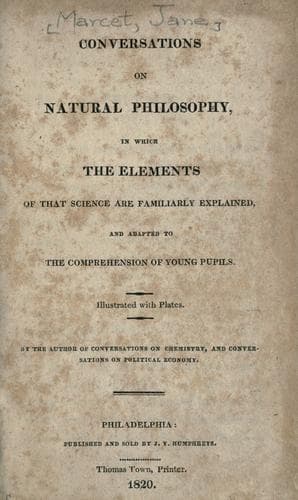
Conversations on Natural Philosophy, in which the Elements of that Science are Familiarly ExplainedMarcet, Mrs. (Jane Haldimand)
Science
Conversations on Natural Philosophy, in which the Elements of that Science are Familiarly Explained
Marcet, Mrs. (Jane Haldimand)
Physics
_Mrs. B._ It is convenient for the demonstration of a variety of
problems in the use of the globes; and besides, the obliquity of this
circle to the equator is rendered more conspicuous by its being
described on the same globe; and the obliquity of the ecliptic shows how
much the earth's axis is inclined to the plane of its orbit. But to
return to fig. 2. plate 8.
The spaces between the several parallel circles on the terrestrial globe
are called zones: that which is comprehended between the tropics is
distinguished by the name of the torrid zone; the spaces which extend
from the tropics to the polar circles, the north and south temperate
zones; and the spaces contained within the polar circles, the frigid
zones. By the term zone is meant a belt, or girdle, the frigid zones,
however, are not belts, but circles, extending 23-1/2 degrees from their
centres, the poles.
The several lines which, you observe to be drawn from one pole to the
other, cutting the equator at right angles, are called meridians; the
number of these is unlimited, as a line passing through any place,
directly to the poles, is called the meridian of that place. When any
one of these meridians is exactly opposite to the sun, it is mid-day, or
twelve o'clock in the day, at all the places situated any where on that
meridian; and, at the places situated on the opposite meridian, it is
consequently midnight.
_Emily._ To places situated equally distant from these two meridians, it
must then be six o'clock.
_Mrs. B._ Yes; if they are to the east of the sun's meridian it is six
o'clock in the afternoon, because they will have previously passed the
sun; if to the west, it is six o'clock in the morning, and that meridian
will be proceeding towards the sun.
Those circles which divide the globe into two equal parts, such as the
equator and the ecliptic, are called greater circles; to distinguish
them from those which divide it into two unequal parts, as the tropics,
and polar circles, which are called lesser circles. All circles, you
know, are imagined to be divided into 360 equal parts, called degrees,
and degrees are again divided into 60 equal parts, called minutes. The
diameter of a circle is a right line drawn across it, and passing
through its centre; were you, for instance, to measure across this round
table, that would give you its diameter; but were you to measure all
round the edge of it, you would then obtain its circumference.
Now Emily, you may tell me exactly how many degrees are contained in a
meridian?
_Emily._ A meridian, reaching from one pole to the other, is half a
circle, and must therefore contain 180 degrees.
_Mrs. B._ Very well; and what number of degrees are there from the
equator to one of the poles?
_Caroline._ The equator being equally distant from either pole, that
distance must be half of a meridian, or a quarter of the circumference
of a circle, and contain 90 degrees.
Public-domain text, read in full here on John Shaqi.
Reviews
Reviews
No reviews yet
Be the first to share your thoughts on this work.
Elsewhere in the archive
Join the Discussion
Join the discussion
Sign in to leave a comment or review.
Sign InorCreate an account