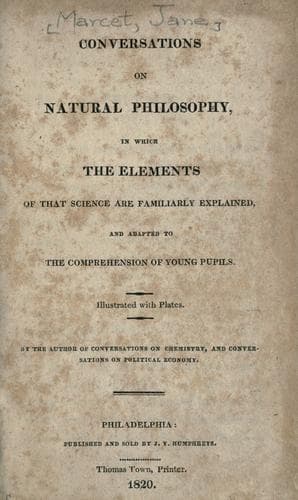
Conversations on Natural Philosophy, in which the Elements of that Science are Familiarly ExplainedMarcet, Mrs. (Jane Haldimand)
Science
Conversations on Natural Philosophy, in which the Elements of that Science are Familiarly Explained
Marcet, Mrs. (Jane Haldimand)
Physics
_Mrs. B._ Besides the usual division of circles into degrees, the
ecliptic is divided into twelve equal parts, called signs, which bear
the name of the constellations through which this circle passes in the
heavens. The degrees measured on the meridians from the equator, either
towards the north, or towards the south, are called degrees of latitude,
of which there may be 90; those measured from east to west, either on
the equator, or any of the lesser circles, are called degrees of
longitude, of which there may be 180; these lesser circles are also
called parallels of latitude. Of these parallels there may be any
number; a circle drawn from east to west, at any distance from the
equator, will always be parallel to it, and is therefore called a
parallel of latitude.
_Emily._ The degrees of longitude must then vary in length, according
to the dimensions of the circle on which they are reckoned; those, for
instance, at the polar circles, will be considerably smaller than those
at the equator?
_Mrs. B._ Certainly; since the degrees of circles of different
dimensions do not vary in number, they must necessarily vary in length.
The degrees of latitude, you may observe, never vary in length; for the
meridians on which they are reckoned are all of the same dimensions.
_Emily._ And of what length is a degree of latitude?
_Mrs. B._ Sixty geographical miles, which is equal to 69-1/2 English
statute miles; or about one-sixth more than a common mile.
_Emily._ The degrees of longitude at the equator, must then be of the
same dimensions, with a degree of latitude.
_Mrs. B._ They would, were the earth a perfect sphere; but it is not
exactly such, being somewhat protuberant about the equator, and
flattened towards the poles. This form proceeds from the superior action
of the centrifugal power at the equator, and as this enlarges the
circle, it must, in the same proportion, increase the length of the
degrees of longitude measured on it.
_Caroline._ I thought I had understood the centrifugal force perfectly,
but I do not comprehend its effects in this instance.
Public-domain text, read in full here on John Shaqi.
Reviews
Reviews
No reviews yet
Be the first to share your thoughts on this work.
Elsewhere in the archive
Join the Discussion
Join the discussion
Sign in to leave a comment or review.
Sign InorCreate an account