It is hardly expected that many will follow Mr. Vehling in testing the
Apician formulæ. Hazlitt in speaking of "The Young Cook's Monitor"
which was printed in 1683, says:
"Some of the ingredients proposed for sauces seem to our
ears rather prodigious. In one place a contemporary
peruser has inserted an ironical calculation in MS. to
the effect that, whereas a cod's head could be bought
for fourpence, the condiments recommended for it were
not to be had for less than nine shillings."
We shall close with a plagiarism oft repeated. It was a plagiarism as
long ago as 1736, when it was admitted such in the preface of Smith's
"The Compleat Housewife":
"It being grown as fashionable for a book now to appear
in public without a preface, as for a lady to appear at
a ball without a hoop-petticoat, I shall conform to the
custom for fashion-sake and not through any necessity.
The subject being both common and universal, needs no
argument to introduce it, and being so necessary for the
gratification of the appetite, stands in need of no
encomiums to allure persons to the practice of it; since
there are but a few nowadays who love not good eating
and drinking...."
Old Apicius and Joseph Dommers Vehling really need no introduction.
FREDERICK STARR
Seattle, Washington, August 3, 1926.
PREFACE
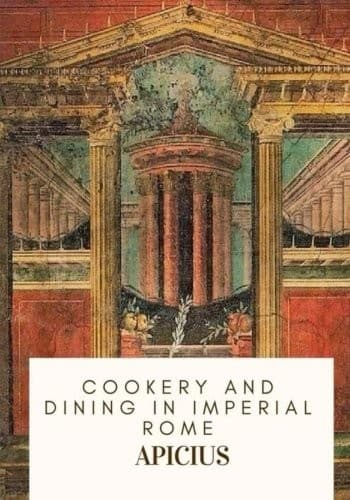
The present first translation into English of the ancient cookery book
dating back to Imperial Roman times known as the Apicius book is
herewith presented to antiquarians, friends of the Antique as well as
to gastronomers, friends of good cheer.
Three of the most ancient manuscript books that exist today bearing
the name of Apicius date back to the eighth and ninth century. Ever
since the invention of printing Apicius has been edited chiefly in the
Latin language. Details of the manuscript books and printed editions
will be found under the heading of Apiciana on the following pages.
The present version has been based chiefly upon three principal Latin
editions, that of Albanus Torinus, 1541, who had for his authority a
codex he found on the island of Megalona, on the editions of Martinus
Lister, 1705-9, who based his work upon that of Humelbergius, 1542,
and the Giarratano-Vollmer edition, 1922.
We have also scrutinized various other editions forming part of our
collection of Apiciana, and as shown by our "family tree of Apicius"
have drawn either directly or indirectly upon every known source for
our information.
The reasons and raison d'être for this undertaking become sufficiently
clear through Dr. Starr's introduction and through the following
critical review.
It has been often said that the way to a man's heart is through his
stomach; so here is hoping that we may find a better way of knowing
old Rome and antique private life through the study of this cookery
book--Europe's oldest and Rome's only one in existence today.
Public-domain text, read in full here on John Shaqi.
Reviews
Reviews
No reviews yet
Be the first to share your thoughts on this work.
Join the Discussion
Join the discussion
Sign in to leave a comment or review.
Sign InorCreate an account