Beagle Expedition (1831-1836); Coral reefs and islands; Geology -- South America; Islands; Volcanoes
Barrier-reefs, when encircling small islands, have been comparatively
little noticed by voyagers; but they well deserve attention. In their
structure they are little less marvellous than atolls, and they give a
singular and most picturesque character to the scenery of the islands
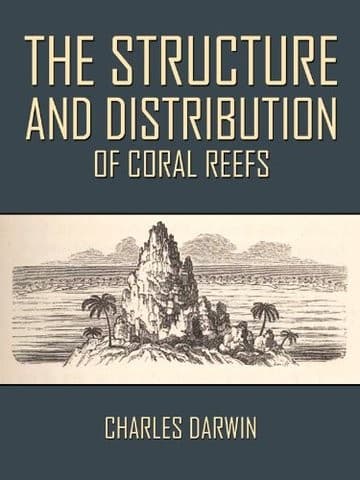
they surround. In the accompanying sketch, taken from the “Voyage of
the ‘Coquille’,” the reef is seen from within, from one of the high
peaks of the island of Bolabola.[1] Here, as in Whitsunday Island, the
whole of that part of the reef which is visible is converted into land.
This is a circumstance of rare occurrence; more usually a snow-white
line of great breakers, with here and there an islet crowned by
cocoa-nut trees, separates the smooth waters of the lagoon-like channel
from the waves of the open sea. The barrier-reefs of Australia and of
New Caledonia, owing to their enormous dimensions, have excited much
attention: in structure and form they resemble those encircling many of
the smaller islands in the Pacific Ocean.
[1] I have taken the liberty of simplifying the foreground, and
leaving out a mountainous island in the far distance.
With respect to fringing, or shore-reefs, there is little in their
structure which needs explanation; and their name expresses their
comparatively small extension. They differ from barrier-reefs in not
lying so far from the shore, and in not having within a broad channel
of deep water. Reefs also occur around submerged banks of sediment and
of worn-down rock; and others are scattered quite irregularly where the
sea is very shallow; these in most respects are allied to those of the
fringing class, but they are of comparatively little interest.
I have given a separate chapter to each of the above classes, and have
described some one reef or island, on which I possessed most
information, as typical; and have afterwards compared it with others of
a like kind. Although this classification is useful from being obvious,
and from including most of the coral-reefs existing in the open sea, it
admits of a more fundamental division into barrier and atoll-formed
reefs on the one hand, where there is a great apparent difficulty with
respect to the foundation on which they must first have grown; and into
fringing-reefs on the other, where, owing to the nature of the slope of
the adjoining land, there is no such difficulty. The two blue tints and
the red colour (replaced by numbers in this edition.) on the map (Plate
III.), represent this main division, as explained in the beginning of
the last chapter. In the Appendix, every existing coral-reef, except
some on the coast of Brazil not included in the map, is briefly
described in geographical order, as far as I possessed information; and
any particular spot may be found by consulting the Index.
Public-domain text, read in full here on John Shaqi.
Reviews
Reviews
No reviews yet
Be the first to share your thoughts on this work.
Join the Discussion
Join the discussion
Sign in to leave a comment or review.
Sign InorCreate an account