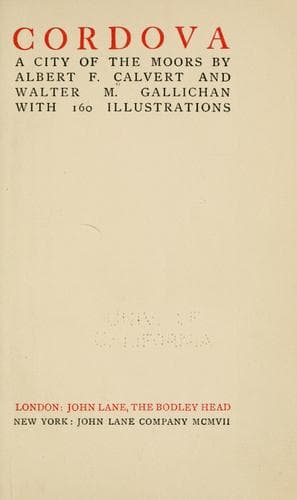
Cordova: A city of the MoorsCalvert, Albert Frederick
History
Cordova: A city of the Moors
Calvert, Albert Frederick
Arabs -- Spain; Córdoba (Spain) -- Description and travel; Córdoba (Spain) -- History
Throughout Europe the mention of Cordova brought yearning to the hearts
of the cultured and studious, and men suffered hardship and stress to
pay pilgrimages to this source of learning. Many who journeyed hither
echoed the words of Ibn Sareh, the poet, which he uttered upon entering
the seat of wisdom: ‘God be praised; I am in Cordova, the abode of
science, the throne of the Sultans!’ Seville was ‘the gem,’ ‘the pearl’
of Andalusia; Cordova was called ‘the Bride.’ El-Makkari, the Moorish
chronicler, rehearses many of the poetical tributes paid by Moslem
writers to the splendid city. Setting forth the culture of the city, he
adds, in one place: ‘The Cordovans were further celebrated for the
elegance and richness of their dress, their attention to religious
duties, their strict observance of the hours of prayer, the high respect
and veneration in which they held their mosque, their aversion to wine
and their destruction of wine-vases wherever they found any, their
abhorrence of every illicit practice, their glory in nobility of descent
and military enterprise, and their success in every department of the
sciences.’
Such were the inhabitants of Cordova at the time when the city was the
great capital of the Mohammedan empire. Seville and Toledo yielded
pre-eminence to Cordova, and men spoke in veneration of its four great
wonders: the immense and gorgeous mosque, the bridge over the
Guadalquivir, the city of Ez-Zahra, situated in the suburbs, and the
sciences which were studied in the colleges.
When we read the ancient annals and grow absorbed by the story of
Cordova’s past, we can scarcely realise that the town and its inmates
were real things. The place and the people seem to belong to the realm
of fairy romance; the city seems one of dreams, and the natives pass as
in a pageant of the imagination. And yet we may enter the sacred
mih-rab, commune with the ghosts of warrior and philosopher, and stand
where Tarik stood when he wrested the prized capital from the Goths.
Tangible evidence of a superb civilisation surrounds us in Cordova. We
see examples of early Moorish architecture brought to its highest
artistic manifestation in the mosque. We listen in vain for the voices
of teachers, the song of the singers and poets, and the call of the
muezzin to devotion; but we tread in the footsteps of the long-vanished
Moor, and read his story in the noble lines, chaste embellishments, and
gorgeous details which his skilful hands produced.
II
THE MOORISH CAPTURE
Public-domain text, read in full here on John Shaqi.
Reviews
Reviews
No reviews yet
Be the first to share your thoughts on this work.
Join the Discussion
Join the discussion
Sign in to leave a comment or review.
Sign InorCreate an account